
How to Pronounce Connected Speech in Natural English
On this page
- What Is Connected Speech?
- Connected Speech Visual Map
- 1) Linking
- 2) Elision
- 3) Assimilation
- Why This Matters for Real Communication
- Before vs After Example
- High-Frequency Phrase Examples
- Mastering How to Pronounce Words in Flow
- Step-by-Step Training Framework
- Common Learner Traps
- Daily Drill (7 Minutes)
- 7-Minute Routine Card
- Advanced 20-Minute Practice (Twice a Week)
- Connected Speech in Exams and Professional Settings
- Self-Evaluation Questions
- Practice the Rhythm Behind Connected Speech
- FAQ
- Advanced Application: Build a Weekly Connected-Speech Lab
- Case Practice Pack: 10 Sentences for Daily Rhythm Training
- Final Takeaway
What Is Connected Speech?
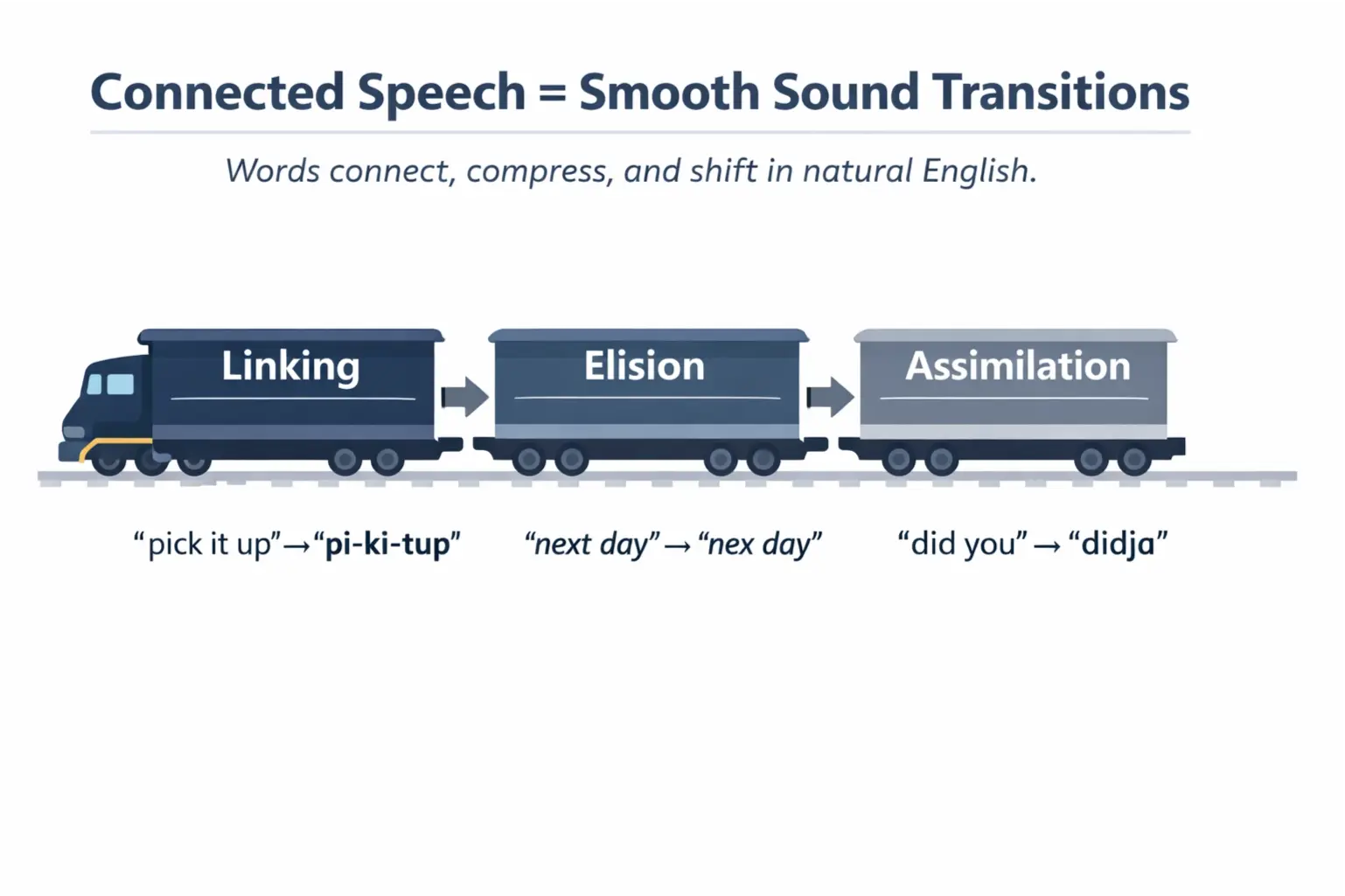
In real conversation, words do not sound isolated. They connect, compress, and shift. This is called connected speech.
Words in a sentence are like train cars. In textbooks they look separated, but in real speech the cars are coupled and move as one chain.
Many learners pronounce individual words correctly, but they can still feel lost in fast listening or unnatural in fast speaking. That gap often comes from connected speech patterns. Native speakers are not speaking "sloppily" by accident. They are using efficient sound transitions. Once you train those transitions, your listening improves and your speaking starts to sound smoother immediately.
Connected Speech Visual Map
1) Linking
Final consonants often link to the next word that starts with a vowel.
- pick it up often sounds like "pi-ki-tup"
- turn off sounds smoother as one flow unit
Linking is like passing a baton in a relay race. If the handoff is smooth, the race keeps momentum. If the handoff is delayed, rhythm breaks. In speech, each sound passes into the next one.
2) Elision
Certain sounds disappear in fast speech for efficiency.
- next day can sound like "nex day"
- friendship may lose a tiny sound in rapid speech
Elision is not random dropping. It happens where pronunciation would be physically slow or awkward. Your mouth chooses the fastest clear path. Think of it as trimming tiny edges to keep sentence flow natural.
3) Assimilation
A sound changes because of a neighboring sound, making pronunciation easier.
- don't you often becomes "don'tcha"
- did you often becomes "didja"
If two paint colors touch, the border softens. In speech, two sounds can blend and create a slightly different result that is easier to pronounce quickly.
Why This Matters for Real Communication
If you pause between every word, listeners may understand your message but still feel extra effort. Smooth connected speech lowers listener effort. This helps in interviews, presentations, meetings, and exam speaking tasks where delivery quality affects overall impression.
Connected speech also improves listening. Once you know that "did you" often sounds like "didja," you stop thinking native speakers are skipping words. You start hearing patterns instead of noise.
Before vs After Example
High-Frequency Phrase Examples
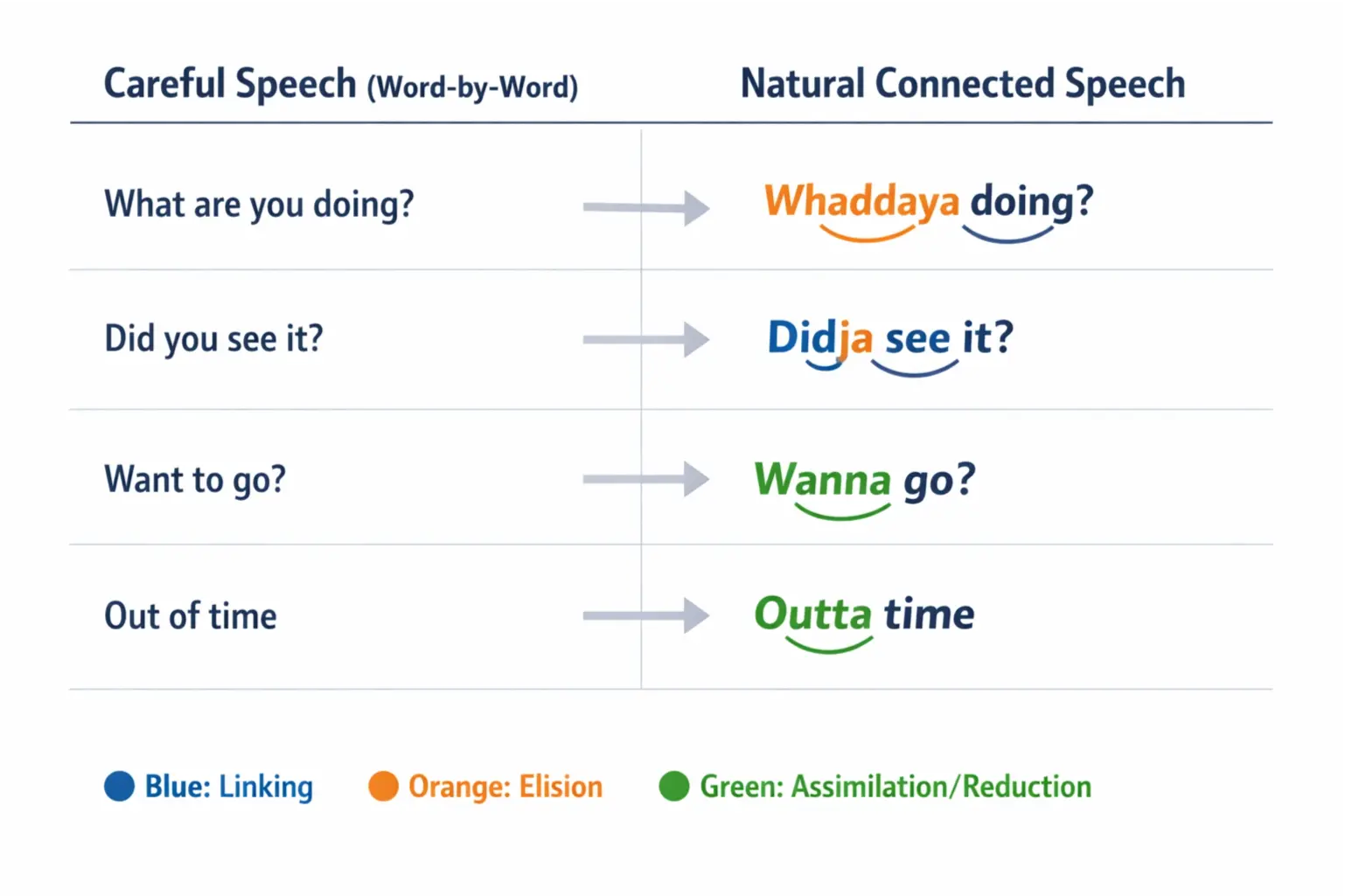
Practice these phrases daily. Read each one in three versions: careful, natural, and conversational fast.
- What are you doing? -> often "Whaddaya" doing?
- Going to -> often "gonna" in casual speech.
- Want to -> often "wanna" in casual speech.
- Could you -> often "couldja" in fast speech.
- Out of -> often "outta" in informal contexts.
- A lot of -> often compressed in rhythm.
Important note: not every reduced form belongs in formal speaking. Train both styles. Use connected rhythm in all contexts, and choose slang-like reductions based on situation.
Mastering How to Pronounce Words in Flow
When analyzing how to pronounce words naturally, the biggest shift happens when you move away from treating dictionary tags as rigid scripts. If you wonder how do you pronounce structural transitions smoothly, it helps to look closely at how unstressed particles alter the baseline pronunciation sound metrics across entire phrasing chunks.
To master how to read or how to pronounce a word contextually, look up your target term on the QuickPronounce main search bar to check its behavior inside live phrase modules. Even searching common variant misspellings like how to pronouce inside text parsers highlights how critical rhythm patterns are when individual vowel boundaries collapse into connected conversational speech.
Step-by-Step Training Framework
- Step 1: Chunking. Break sentences into thought groups instead of individual words.
- Step 2: Stress mapping. Mark content words that should be stronger.
- Step 3: Link points. Identify consonant-to-vowel transitions.
- Step 4: Reduction points. Mark weak function words that can reduce.
- Step 5: Shadow and compare. Copy a model recording, then compare rhythm and pacing.
- Step 6: Free speaking transfer. Use the same pattern in your own spontaneous responses.
Common Learner Traps
Trap 1: focusing only on word pronunciation lists. Word accuracy helps, but sentence flow is where fluency is judged.
Trap 2: speaking too carefully at all times. Over-control can kill rhythm.
Trap 3: copying slang reductions without mastering stress patterns first.
Trap 4: skipping recording. You cannot improve what you do not hear.
Daily Drill (7 Minutes)
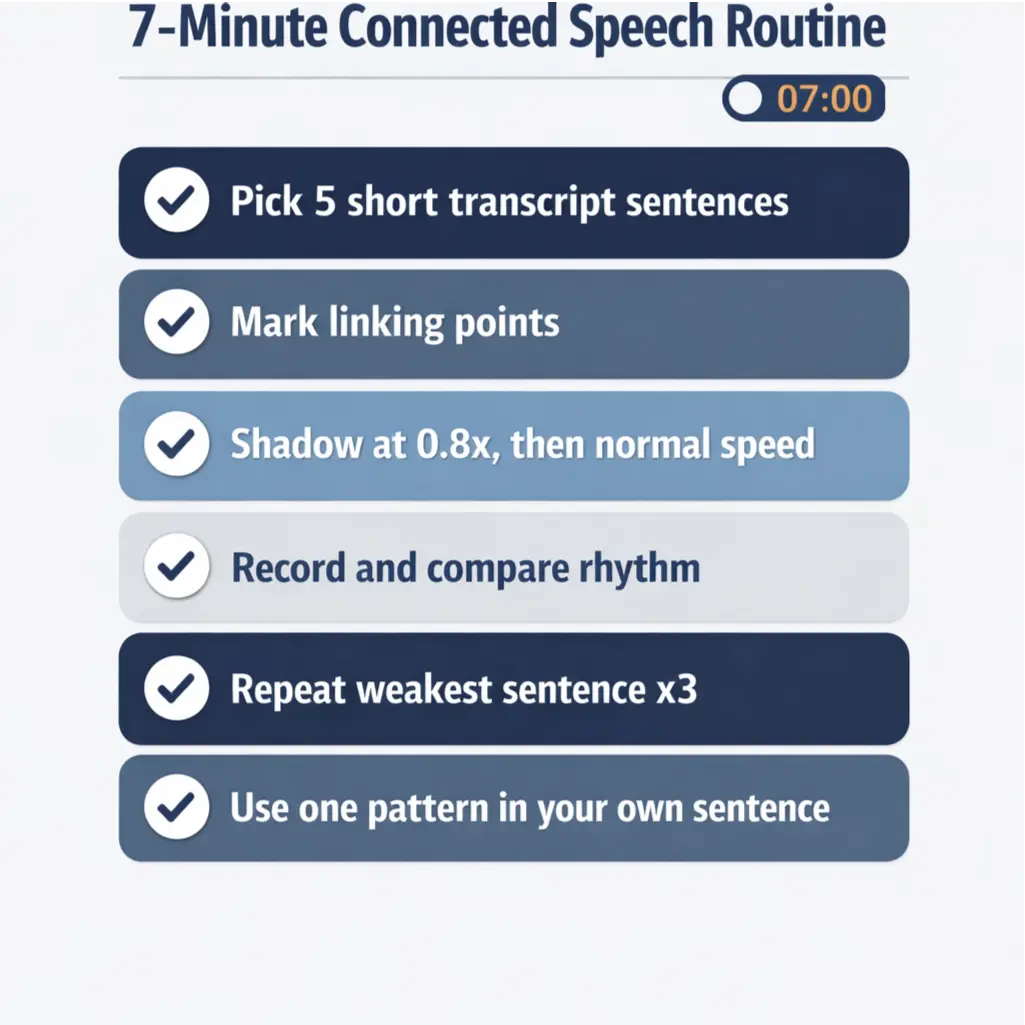
- Choose 5 short sentences from a podcast transcript.
- Underline likely linking points.
- Shadow the speaker at 0.8x speed, then normal speed.
- Record your version and compare sentence rhythm.
- Repeat your weakest sentence three extra times.
- Use one sentence pattern in your own original sentence.
7-Minute Routine Card
Advanced 20-Minute Practice (Twice a Week)
If you want faster improvement, run this deeper practice block two times per week:
- Pick a 60 to 90 second clip with transcript.
- Listen once for meaning, not pronunciation.
- Listen again and mark linking, elision, and assimilation.
- Shadow line by line at reduced playback speed.
- Shadow full passage at normal speed.
- Record your own version and compare wave rhythm.
- Write three reflection notes and one fix target.
This method gives you both listening and speaking gains because it trains pattern recognition and motor output together.
Connected Speech in Exams and Professional Settings
You do not need heavy slang reductions for exams or work. What you need is smooth phrasing, correct stress, and natural linking. For IELTS or interviews, connected speech helps you sound comfortable and coherent without forcing a fake accent.
In professional communication, clarity remains priority one. Use moderate reductions and clear thought-group pausing. Aim for understandable naturalness, not maximum speed.
Self-Evaluation Questions
- Did I keep thought groups smooth, not word-by-word?
- Did I reduce unstressed function words naturally?
- Did my pace stay clear while sounding connected?
- Did I preserve meaning and emphasis where needed?
Practice the Rhythm Behind Connected Speech
Quick practice
Test your ear with the Word Stress quiz
Connected speech sits on top of correct stress and rhythm. Once your word stress is solid, linking and reduction start to feel natural. Run a few timed rounds and see where your ear is.
Take the Word Stress quiz →FAQ
Do I need to sound very fast to use connected speech?
No. Connected speech is about smooth transitions, not speed alone.
Will connected speech reduce clarity?
Good connected speech improves clarity because rhythm highlights key information.
What are the main types of connected speech?
Four come up most often: linking (joining a final consonant to a following vowel), elision (dropping a sound, like the 't' in 'nex(t) week'), assimilation (one sound shifting to match a nearby one, so 'ten bikes' sounds closer to 'tem bikes'), and weak forms (reducing function words like 'to' and 'of' to a schwa).
Does connected speech work the same in every accent?
The principles are the same, but the specific reductions vary. American and British English link and elide in slightly different places, so match your practice audio to the accent you want.
Should beginners learn connected speech?
Yes, mainly for listening. Knowing that natural speech links and reduces sounds makes fast audio much easier to follow. Producing it comfortably comes later.
How long to notice improvement?
With daily short drills and recording, most learners notice better flow in 2 to 4 weeks.
Advanced Application: Build a Weekly Connected-Speech Lab
If you want major fluency growth, create a personal connected-speech lab each week. Choose one short audio source such as a podcast excerpt, interview clip, or presentation segment. Keep it under two minutes so analysis stays focused. Day 1: listen for general meaning and identify thought groups. Day 2: annotate linking points and weak forms. Day 3: annotate possible elision and assimilation. Day 4: shadow slowly. Day 5: shadow at natural speed. Day 6: deliver your own version without transcript. Day 7: reflect and set one correction target.
This lab method works because it combines input and output repeatedly on the same material. Many learners switch material too often and never develop deep pattern memory. Reusing one short passage for a full week allows your brain to automate transitions that were difficult on day one.
For classroom or team learning, assign roles: one speaker, one rhythm coach, one clarity monitor. The rhythm coach tracks linking and stress. The clarity monitor ensures intelligibility remains high. This dual focus prevents a common mistake: speaking fast but unclear. Natural connected speech is not careless speed. It is efficient clarity.
In professional contexts, use connected-speech training on your own real scripts: project updates, product demos, interview introductions, and meeting summaries. When practice material matches your real use case, transfer happens much faster. You will not just "sound better" in drills; you will sound better when the stakes are real.
Keep a minimal scorecard with three metrics: smoothness, clarity, and confidence. Rate each from 1 to 5 after every weekly lab. Over one month, you should see clear trend improvement. This makes pronunciation progress visible and keeps motivation high.
Case Practice Pack: 10 Sentences for Daily Rhythm Training
Use this mini pack to train consistency. Read each sentence first in clear slow speech, then in natural connected flow, then in your own expressive style. Keep meaning active while you speak.
- I wanted to ask you about the update before lunch.
- Could you send it over when you get a chance?
- We need to make a decision by the end of the day.
- I looked at the report and wrote a short summary.
- Did you check the numbers from last month yet?
- Let me know if you want to go over it together.
- She said she was going to call the client later.
- We can work it out if we plan the timeline clearly.
- I had a lot of ideas, but we picked two priorities.
- When you are ready, we can start with the first item.
Record this pack once per week. Compare week one and week four for smoother linking, better weak-form control, and fewer abrupt word boundaries. This simple repetition system creates visible improvement without requiring complex tools.
Final Takeaway
Connected speech is the engine of natural English rhythm. Train linking, elision, and assimilation as practical habits, not abstract theory. Keep your routine simple: listen, mark, shadow, record, compare, and transfer to your own speaking. When transitions become smoother, listening gets easier, speaking feels less effortful, and your overall fluency impression rises in every context that matters.
Start Practicing
Use QuickPronounce to check IPA, compare accents, and improve clarity.
Open QuickPronounce