
How to Pronounce the Schwa Sound: The Relaxed English Vowel
On this page
- Why Schwa Matters More Than Most Learners Realize
- Schwa Mouth and Stress Visual
- What Schwa Sounds Like in Real Words
- Why Schwa Feels Difficult at First
- Common Mistakes and How to Fix Them
- High-Value Example Set (Use for Repetition)
- 20-Word Schwa Practice List
- 5-Minute Daily Drill (Beginner Version)
- 10-Minute Daily Drill (Intermediate Version)
- Schwa in Connected Speech
- Rhythm Waveform Visual
- Quick Diagnostic: Are You Using Schwa Enough?
- FAQ
- Extended Practice Workbook (Fill This Over 30 Days)
- Case Study: From Clear But Stiff to Natural and Clear
- Final Takeaway
- Search Questions & Quick Answers
Why Schwa Matters More Than Most Learners Realize
Many English learners spend months memorizing difficult consonants, accent differences, and advanced vocabulary, but still feel that their speech sounds "bookish" or "over-pronounced." In most cases, the missing piece is not a fancy sound. It is rhythm. And the fastest way to improve rhythm is to learn the schwa sound well.
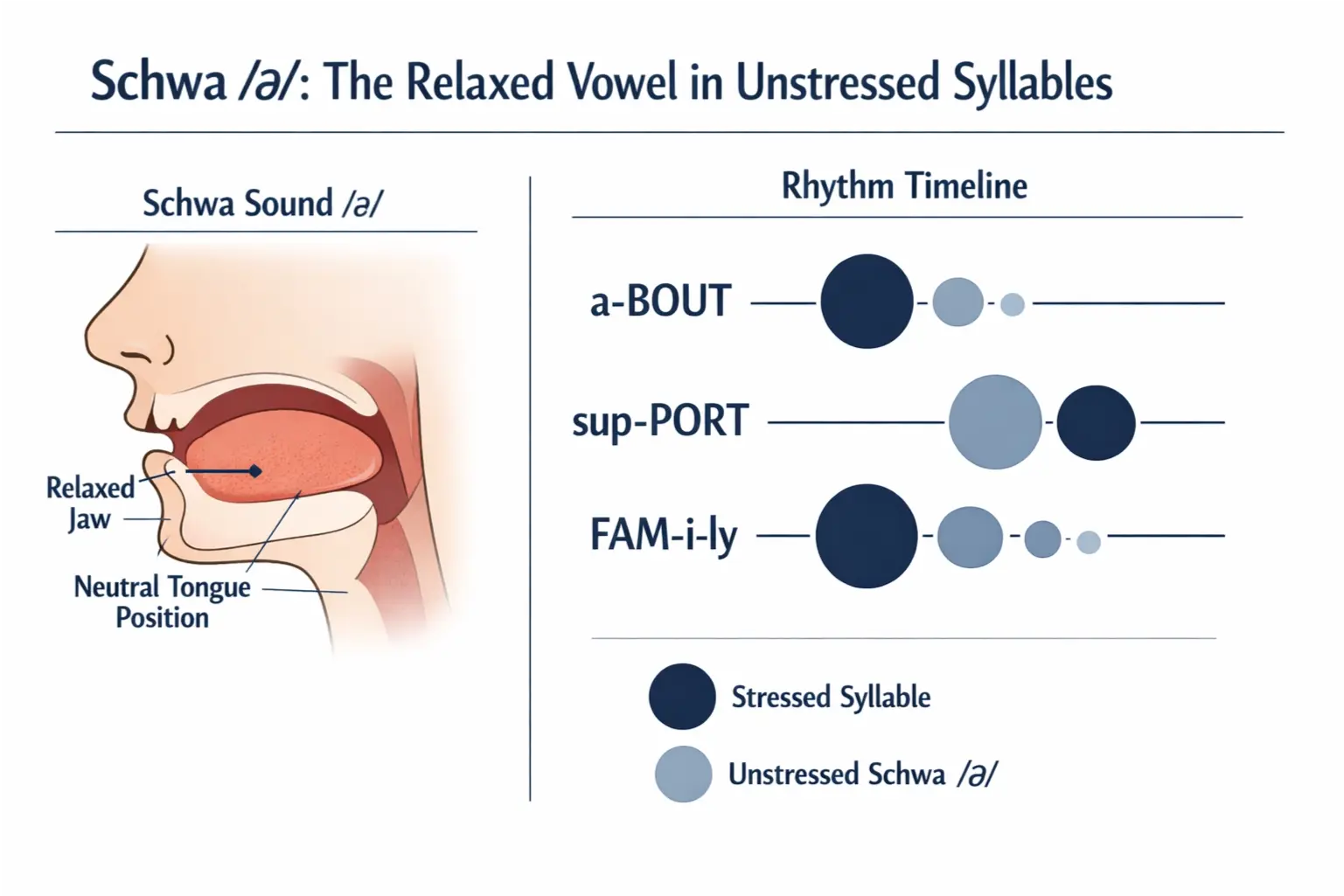
Schwa is the weak, relaxed vowel that appears in unstressed syllables. You hear it constantly in natural speech: about, support, problem, family, banana, today, and thousands of other words. If every syllable in your sentence has equal force, native listeners can still understand you, but your speech may sound stiff and unnatural.
Think of schwa as your voice's "idle mode." A car engine at a signal is still running, but it is not pushing at full power. English works similarly. Stressed syllables carry energy and meaning. Unstressed syllables often reduce into a softer, lighter vowel. That soft vowel is usually schwa.
Another analogy is music. If a drummer hits every beat at maximum volume, the groove disappears. Good rhythm needs strong beats and weak beats. Schwa creates those weak beats in spoken English. Without it, your speech loses contrast. With it, your speech breathes.
Schwa Mouth and Stress Visual
What Schwa Sounds Like in Real Words
Schwa is often represented as "uh" in simple learner notation. You do not hold it long, and you do not make it very clear. It is brief and neutral. Here are common examples with stress pattern notes:
- about: first syllable weak, second syllable strong.
- support: first syllable weak, second syllable strong.
- problem: first syllable strong, second syllable reduced.
- family: middle syllable reduced.
- today: first syllable weak, second syllable strong.
- photograph: first syllable stronger, middle unstressed syllable reduced.
- chocolate (common fast speech): middle vowel can reduce strongly.
Key idea: schwa is not tied to one letter. It can come from a, e, i, o, or u when that syllable is unstressed. English spelling does not tell you stress reliably, so you should train your ear first, then your mouth.
Why Schwa Feels Difficult at First
Learners from syllable-timed language backgrounds often pronounce each syllable with similar length and energy. English, however, is stress-timed. That means important syllables are clearer and longer, while other syllables compress. If this rhythm model is new for you, schwa may feel "lazy" or "incorrect" in the beginning.
It is not lazy. It is efficient. Native speakers reduce unstressed vowels to keep sentence flow fast and smooth. Mastering schwa does not reduce clarity. It improves clarity because listeners can hear which parts are stressed and meaningful.
Common Mistakes and How to Fix Them
Mistake 1: giving every syllable full strength. Fix: mark one stressed syllable per word first, then soften the rest.
Mistake 2: trusting spelling more than sound. Fix: use dictionary audio or speech models and copy stress before copying letters.
Mistake 3: practicing isolated words only. Fix: move quickly to short phrases and full sentences, because schwa becomes clearer in rhythm.
Mistake 4: over-correcting with very weak, unclear speech. Fix: keep stressed syllables crisp; reduce only unstressed syllables.
High-Value Example Set (Use for Repetition)
Practice these words in slow, normal, and fast speeds. Focus on contrast between stressed and unstressed syllables.
- ago, around, away, above
- accept, support, suggest, connect
- problem, system, item, lesson
- banana, camera, family, memory
Sentence practice: "I was about to accept the offer when my family called." Read once for accuracy, then once for rhythm.
20-Word Schwa Practice List
Stress guide: CAPS = stressed syllable, and (uh-) marks a schwa in an unstressed syllable.
- (uh)-BOUT
- (suh)-PORT
- PROB-(uh)m
- FAM-(uh)-lee
- buh-NA-nuh
- (tuh)-DAY
- (uh)-CEPT
- suh-GEST
- (kuh)-NECT
- (uh)-ROUND
- (uh)-WAY
- (uh)-BOVE
- SYS-(tuh)m
- EYE-(tuh)m
- LES-(uh)n
- CAM-(uh)-ruh
- MEM-(uh)-ree
- (uh)-GO
- PHO-(tuh)-graph
- CHOC-(uh)-lit
5-Minute Daily Drill (Beginner Version)
- Pick 5 multisyllable words from your class or daily life.
- Mark the stressed syllable in each word with a capital letter.
- Say each word slowly 3 times.
- Say each word naturally 3 times.
- Use each word in one sentence and record yourself.
- Compare your version with dictionary audio and note one fix.
10-Minute Daily Drill (Intermediate Version)
- Choose 8 words and 4 short sentences that include them.
- Identify stress pattern for each target word.
- Read word list with strong/weak contrast.
- Read sentence list with natural rhythm.
- Shadow a native sample at 0.8x speed, then 1.0x speed.
- Record your own final pass and score yourself from 1 to 5.
Consistency matters more than session length. Ten focused minutes each day beats one long session each week.
Schwa in Connected Speech
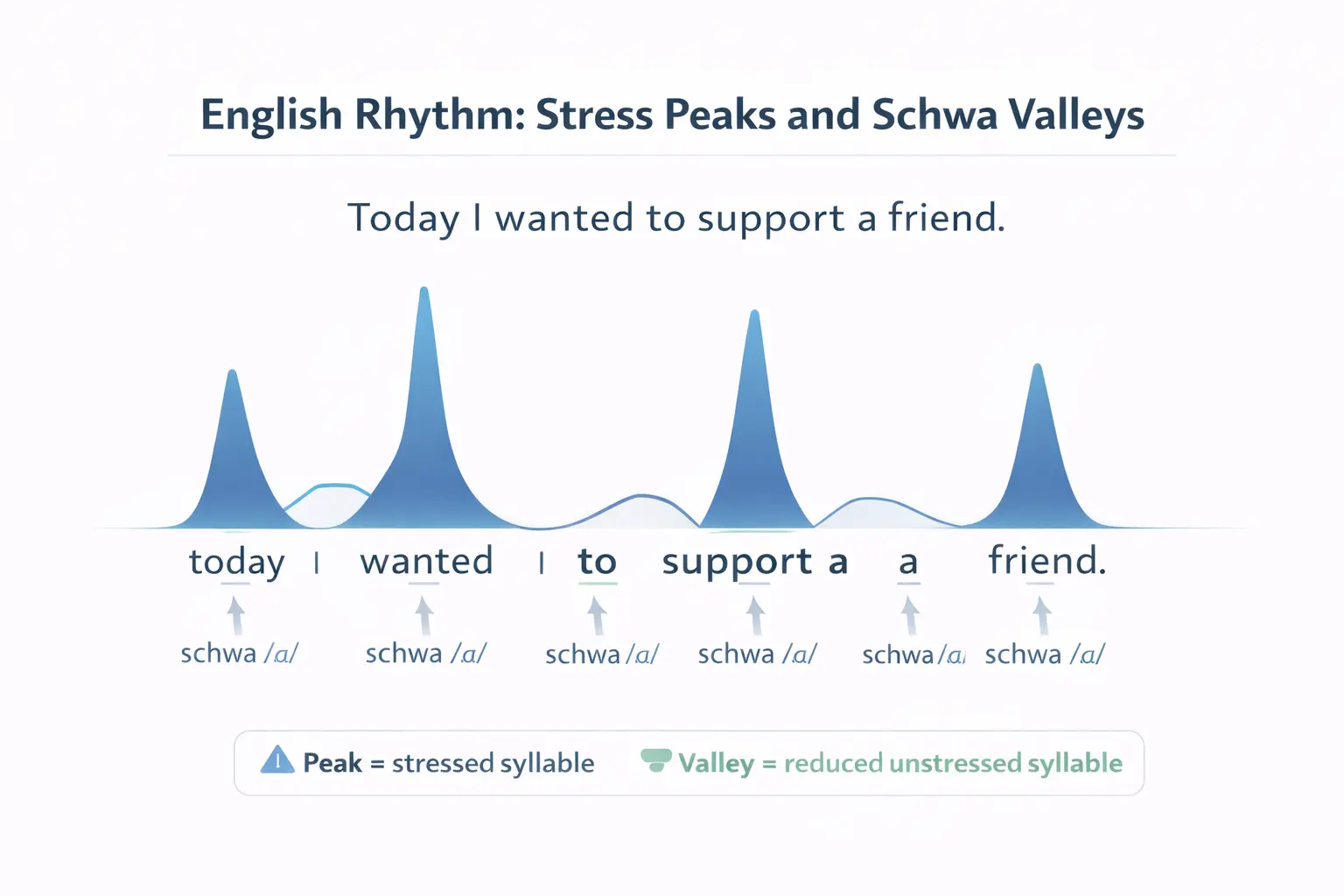
Schwa is not only a word-level concept. It drives sentence rhythm. Function words such as to, a, of, for, and can often reduce when unstressed.
- "I want to go" often sounds like "I wan(t) tuh go."
- "A cup of tea" often sounds like "uh cup uh tea."
- "I can do it" in neutral speech may reduce "can" to a weak form.
If you keep every function word strong, listeners still understand you, but your rhythm may sound less natural. Start by reducing one function word per sentence, then expand.
If you're writing an app or extension that needs to show where the schwa falls, the QuickPronounce phonetic API returns IPA for US and UK plus a syllable breakdown with a primary-stress flag, so you can mark the reduced syllables in your own UI. Free while in public testing, one API key by email.
Rhythm Waveform Visual
Quick Diagnostic: Are You Using Schwa Enough?
Read this mini paragraph aloud and record it: "Today I wanted to support a friend, so I arranged a banana smoothie and a quick plan for tomorrow." Then listen back and ask:
- Did my stressed syllables stand out clearly?
- Did unstressed syllables feel lighter and shorter?
- Did my rhythm sound smooth instead of word-by-word?
- Did I over-pronounce any small function words?
FAQ
Do I need schwa to be understood?
You can be understood without perfect schwa, but using it improves natural rhythm and listening comfort for your audience.
Is schwa the same in all accents?
The exact quality may vary slightly by accent, but vowel reduction in unstressed syllables is common across major English varieties.
How long before I hear improvement?
Most learners notice rhythm improvement in 2 to 3 weeks with daily recording and comparison.
Extended Practice Workbook (Fill This Over 30 Days)
Use this guided workbook structure if you want a concrete way to push your schwa control to a professional level. Week 1 should focus on awareness: listening, stress detection, and mouth relaxation. Week 2 should focus on controlled production at word and phrase level. Week 3 should focus on sentence rhythm and function-word reduction. Week 4 should focus on live speaking transfer in meetings, class discussions, and unscripted answers.
Daily journal prompt: choose three words and one sentence from your day. Mark stress, practice each item in slow and natural speech, then write one sentence reflection about what improved. Example reflection: "Today my stressed syllables were clear, but I still over-pronounced 'to' and 'of.'" Tiny daily reflection creates a feedback loop that is more powerful than passive repetition.
Weekly checkpoint task: record a 60-second summary of your week. Then replay and highlight unstressed syllables that remained too strong. Do not judge your accent identity. Judge only rhythm contrast. Your goal is not to sound like someone else. Your goal is to sound clear, confident, and naturally timed.
Performance scenario drill: practice this structure for interviews or presentations. Start with a prepared answer, then produce a spontaneous version. Compare them. Most learners can reduce schwa correctly in the prepared version but lose it in spontaneous speech. Train both until rhythm remains stable. If this feels hard, lower speaking speed by 10 percent and rebuild control.
Long-term rule: never separate pronunciation from meaning. When you practice schwa, decide where your message emphasis should be. Strong ideas need strong stress. Supporting words need reduced stress. This meaning-first approach keeps pronunciation training practical and prevents robotic delivery.
Case Study: From Clear But Stiff to Natural and Clear
Consider a learner who already had strong grammar and vocabulary but felt that presentations sounded unnatural. In recordings, every syllable had equal force. Listeners described the speech as "correct but heavy." The learner began a three-part schwa routine: stress marking, function-word reduction, and sentence shadowing. In week one, the goal was awareness only. In week two, word-level reduction became stable. By week three, sentence rhythm improved enough that listeners reported better comfort and easier comprehension.
What changed most was not accent color. What changed was contrast. Key words became clearer because surrounding syllables became lighter. This is an important mindset shift. Pronunciation improvement is often about contrast management rather than perfect sound imitation. When stressed syllables and unstressed syllables are clearly differentiated, speech sounds more organized and professional.
You can run this same experiment on yourself. Choose one one-minute speaking topic and record it every Sunday for a month. Keep topic and speed similar each week. On each version, score three items from 1 to 5: stress contrast, reduced syllable control, and overall naturalness. Review your trend line after four recordings. Most learners see a clear rise when practice is short, focused, and daily.
Final Takeaway
Schwa is small, but its impact is huge. It is the bridge between correct pronunciation and natural pronunciation. Focus on stress first, reduce unstressed vowels second, and practice in full sentences. Keep your routine short, daily, and measurable. Over time, your speech will sound less forced and more fluent, even before your vocabulary grows.
Search Questions & Quick Answers
How do I practice schwa quickly?
Do short daily drills: pick 5 multisyllable words, mark stress, say slowly, then shadow at normal speed. Record and compare.
Can I hear schwa in audio examples?
Yes. Use the site audio and slow playback to spot reduced vowels in natural sentences; schwa often sounds like a quick "uh".
Will schwa help my overall speaking clarity?
Yes; reducing unstressed syllables improves rhythm and makes important words stand out for listeners.
Where can I get pronunciation audio free online?
QuickPronounce provides free pronunciation audio across multiple accents; use the slow playback to spot reduced vowels and confirm schwa in context.
Is there an online pronunciation tool or app?
Yes; QuickPronounce is optimized for mobile and desktop with IPA and audio built-in for fast practice.
Start Practicing
Use QuickPronounce to check IPA, compare accents, and improve clarity.
Open QuickPronounce