
How to Improve IELTS Speaking Pronunciation: Practical Training Plan
On this page
- Introduction: Why Pronunciation Decides Your Band Score
- 1. What Band 9 Pronunciation Really Means
- 2. The Most Common Pronunciation Mistakes (That Kill Scores)
- 3. High-Value IELTS Vocabulary (With Correct Pronunciation)
- 4. Connected Speech: The Band 9 Separator
- How to Pronounce Phrases and Complex Words Under Exam Pressure
- 5. A Realistic 30-Day Pronunciation Plan
- 6. Speaking Task Transfer: From Practice to Exam Performance
- Frequently Asked Questions
- Conclusion: Clarity Beats Perfection
Introduction: Why Pronunciation Decides Your Band Score
Many IELTS candidates believe that pronunciation means copying a British or American accent. This misconception causes unnecessary stress and often damages fluency. In reality, IELTS examiners are not trained to reward accents - they are trained to reward clarity, consistency, and ease of understanding.
Pronunciation contributes 25% of your IELTS Speaking score. That means even strong vocabulary and grammar cannot fully compensate for unclear sounds, incorrect stress, or robotic speech. This is why many candidates remain stuck at Band 6.5–7.5 despite years of English study.
This guide explains what Band 9 pronunciation actually means, how examiners evaluate it, and how you can train efficiently using phonetics, connected speech, and structured listening practice with tools like QuickPronounce.
1. What Band 9 Pronunciation Really Means
According to official IELTS descriptors, a Band 9 speaker uses a full range of pronunciation features with precision and subtlety. This sounds vague - but in practice, examiners focus on three core elements:
- Individual Sounds: Clear vowels and consonants without confusion (e.g., ship vs sheep, law vs low).
- Word Stress: Correct stress placement that does not distort meaning (PHO-to-graph vs pho-TOG-ra-pher).
- Connected Speech: Natural flow using linking, reduction, and rhythm instead of word-by-word speaking.
Examiners do not deduct marks for your accent. They deduct marks when pronunciation forces them to mentally decode what you are saying.
2. The Most Common Pronunciation Mistakes (That Kill Scores)
Even advanced speakers lose marks due to predictable pronunciation issues. These mistakes appear across all native language backgrounds:
- Speaking too clearly - refusing to reduce sounds like to, of, for
- Incorrect vowel length (live vs leave, full vs fool)
- Flat intonation that sounds memorized or unnatural
- Overthinking accent instead of intelligibility
Fixing these does not require memorizing rules. It requires ear training - repeatedly hearing correct patterns and reproducing them naturally.
3. High-Value IELTS Vocabulary (With Correct Pronunciation)
Advanced vocabulary helps only if pronunciation supports it. Mispronouncing a big word is worse than using a simple word correctly. Below are IELTS-relevant words with IPA clarity:
/səˈsteɪnəbl/
Sustainable
/ˈɪnfrəstrʌktʃər/
Infrastructure
/fəˈnɒmɪnən/
Phenomenon
/ˌhaɪəˈrɑːrkɪkl/
Hierarchical
On QuickPronounce, practice these words at slow speed first, then shadow at normal speed to internalize rhythm and stress.
4. Connected Speech: The Band 9 Separator
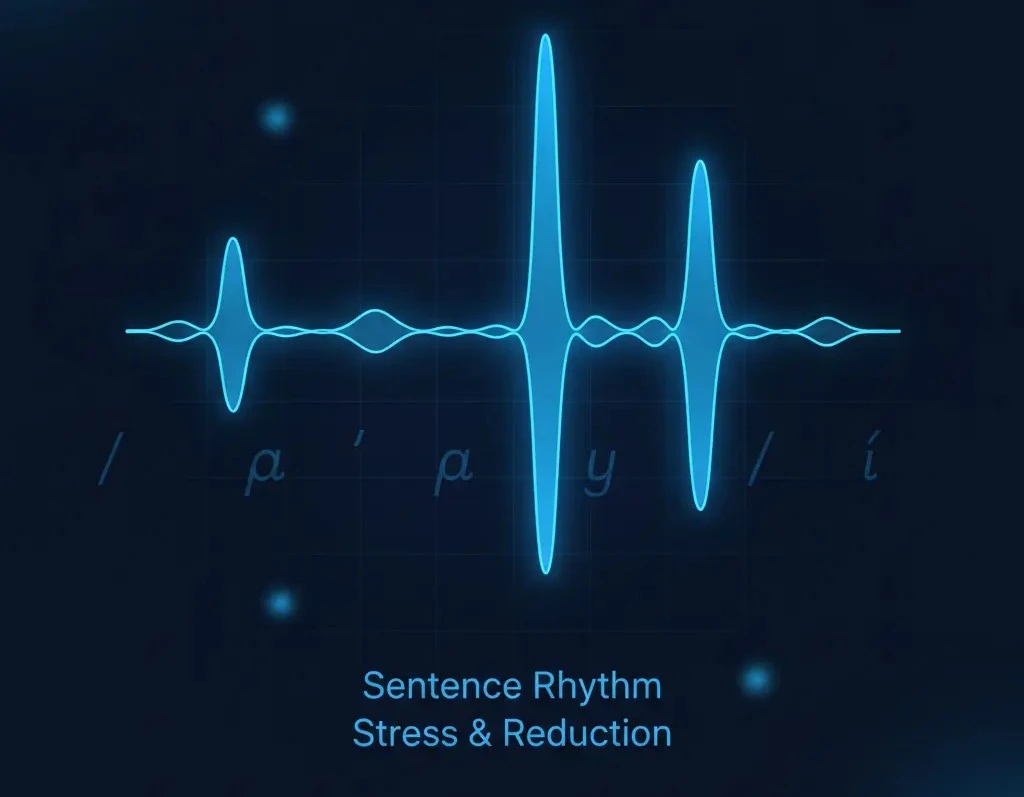
IELTS examiners instantly hear whether speech is natural. Native-like fluency comes from connected speech, not speed.
Linking
"An apple" -> "a-napple"
Sound Reduction
"want to" -> "wanna" (acceptable in speaking)
Intrusive Sounds
"go away" -> "go-w-away"
How to Pronounce Phrases and Complex Words Under Exam Pressure
When candidates are thrown into abstract Part 3 discussions, figuring out exactly how to pronounce academic vocabulary on the fly can stall lexical processing speed. If you are struggling with a complex lexical segment and wondering how do you say long multi-syllable items rhythmically without halting, the solution lies in identifying the primary vowel anchor beforehand.
Before taking the live exam, running difficult topic groupings through the QuickPronounce audio analysis widget ensures your muscle memory handles stress positioning shifts naturally, preserving your general fluency metrics when speech velocity accelerates.
5. A Realistic 30-Day Pronunciation Plan
- Days 1–10: Listening only. Train your ear using multiple accents.
- Days 11–20: Shadowing practice with IPA support.
- Days 21–30: Record answers and self-compare.
This approach builds muscle memory - the same principle athletes use to train form before speed.
6. Speaking Task Transfer: From Practice to Exam Performance
Many candidates practice pronunciation in isolation but lose control during live speaking tasks. To avoid this, transfer your drills into IELTS-style responses. After practicing a target pattern (for example stress or linking), immediately use it in a Part 2 mini-talk and a Part 3 opinion answer. This bridges the gap between practice mode and exam mode.
A practical method is the "1-2-1 cycle": one short model answer, two self-recorded attempts, and one corrected final version. This creates fast feedback while keeping pressure realistic. Focus on clarity first, then pacing, then expression. If your message remains understandable at natural speed, your pronunciation performance is moving in the right direction.
Frequently Asked Questions
Do I need a British accent for IELTS?
No. IELTS accepts all international accents if pronunciation is clear.
Can pronunciation alone raise my band score?
Yes. Many candidates jump from 7 to 8 simply by improving clarity and rhythm.
Conclusion: Clarity Beats Perfection
IELTS Speaking is not a performance - it is communication. When pronunciation becomes automatic, your ideas flow freely. Focus on intelligibility, not imitation.
Train smart, listen deeply, and speak confidently. A Band 9 is not about sounding native - it is about being understood effortlessly.
Get pronunciation as you read: the QuickPronounce extension works on any page, not just this one.
Add to ChromePractice Real Pronunciation, Not Guesswork
Explore phonetic breakdowns, slow audio, and accent comparisons on QuickPronounce.
Start Practicing Now