
How to Pronounce Words with Correct English Word Stress
On this page
- Why Word Stress Is More Important Than Most Learners Think
- Word Stress Map: Strong vs Weak Syllables
- How Stress Changes Meaning: Noun vs Verb Pairs
- Analogy: Word Stress Is Like Camera Focus
- High-Value Rules: Quick Reference
- Everyday Examples by Scenario
- Stress and Schwa: Why Weak Syllables Matter Too
- Two-Syllable Stress Chart: Nouns vs Verbs
- Stress in Connected Speech: Beyond Single Words
- A Practical 10-Minute Daily Routine
- Common Mistakes That Keep Stress from Improving
- Practice the Pattern
- Final Takeaway: Clarity Is a Rhythm Skill
- Quick Answers
Why Word Stress Is More Important Than Most Learners Think
Many learners spend years memorising vocabulary and grammar yet still hear, “Sorry, what did you say?” The problem is often not pronunciation itself but word stress.
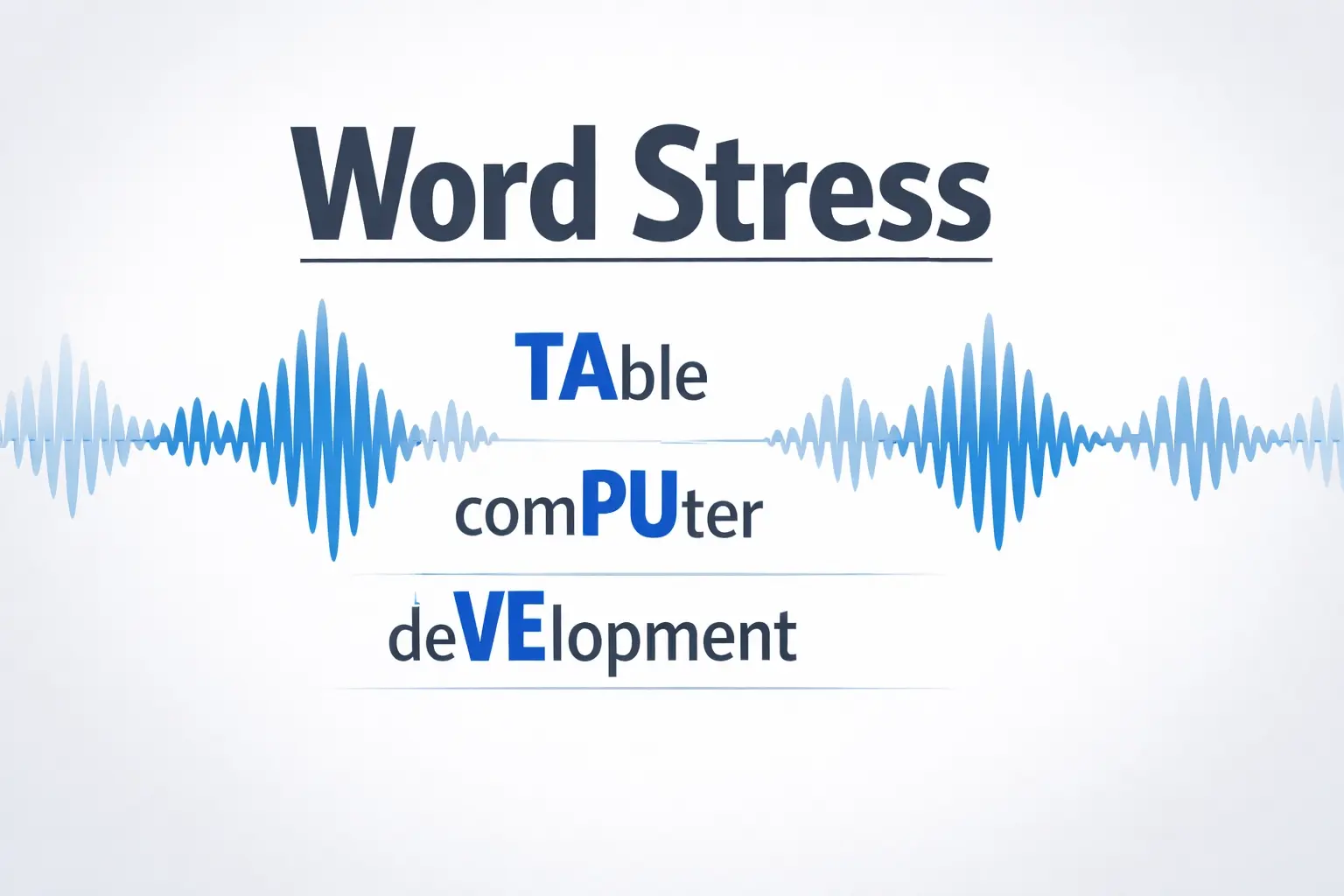
Word stress is the beat pattern of English. One syllable is stronger, clearer, and longer; the others are lighter and faster. If stress lands on the wrong syllable, listeners may need extra effort to decode your meaning. Sometimes they hesitate. Sometimes they misunderstand entirely.
Think of a street address where one number is highlighted. That highlight helps you find the exact location. Stress works in the same way. It highlights the “address” of a word within a sentence. Without it, speech can sound flat, robotic, or even unclear.
The good news: word stress is trainable. You do not need a perfect accent. You need predictable rhythm. Once your stress pattern improves, your speech sounds clearer, more natural, and more confident in everyday conversation, meetings, and exams.
Word Stress Map: Strong vs Weak Syllables
How Stress Changes Meaning: Noun vs Verb Pairs
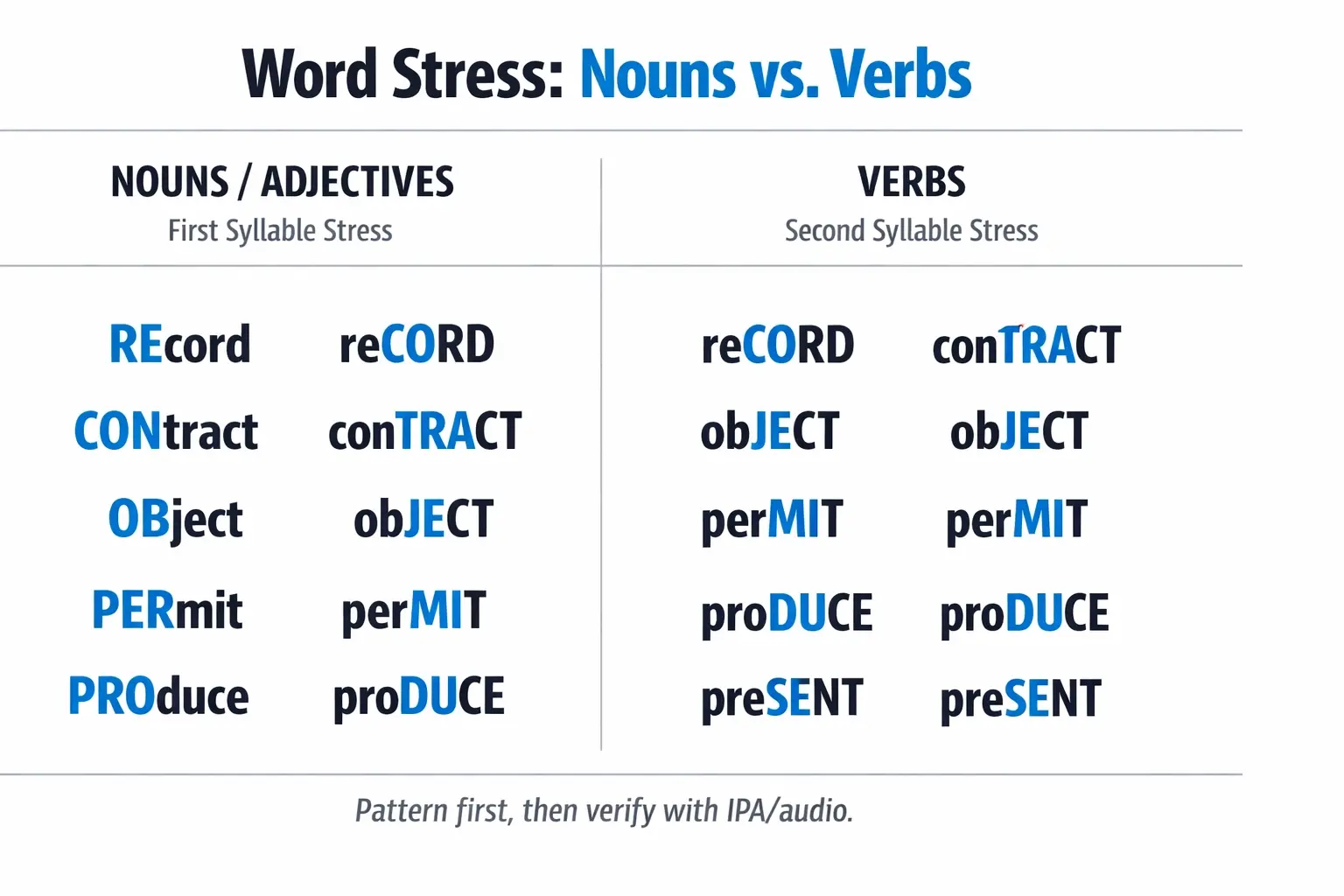
In English, some two syllable words change their grammatical role and even their meaning depending on which syllable carries the stress. This is one of the most valuable patterns to master because it appears in business English, academic speech, and everyday conversation.
| Word | Noun / Adjective | Verb | Example sentence (noun → verb) |
|---|---|---|---|
| record | REcord | reCORD | Play the REcord / reCORD the meeting. |
| present | PREsent | preSENT | See the PREsent draft / preSENT the results. |
| contract | CONtract | conTRACT | Sign the CONtract / conTRACT the vendor. |
| object | OBject | obJECT | Move the OBject / obJECT to the plan. |
| permit | PERmit | perMIT | Need a PERmit / will they perMIT it? |
| produce | PROduce | proDUCE | Buy fresh PROduce / farms proDUCE it. |
| protest | PROtest | proTEST | Join the PROtest / proTEST the decision. |
| increase | INcrease | inCREASE | A 10% INcrease / costs inCREASE yearly. |
If stress is misplaced, listeners often pause to decide whether you meant a thing (noun) or an action (verb). That tiny hesitation is exactly what strong pronunciation training removes.
Analogy: Word Stress Is Like Camera Focus
In a portrait, the subject is sharp while the background is softer. Speech works in a similar way. The stressed syllable stands out, while unstressed syllables stay softer. When every syllable is spoken with equal emphasis, listeners lose the sense of where the word’s centre is, much like a photo where everything is equally sharp and visually busy.
Advanced pronunciation is not about speaking louder. It is about creating contrast. Strong syllables and weak syllables should not be equal. Rhythm needs shape.
High-Value Rules: Quick Reference
English has exceptions, but these five patterns will cover the majority of words you encounter every day.
Rule 1
Two-syllable nouns & adjectives
TAble · QUIet · HAPpy
Rule 2
Two-syllable verbs
reLAX · arRIVE · deCIDE
Rule 3
Endings: -tion / -sion
eduCAtion · reVIsion
Rule 4
Endings: -ic
geoGRAphic · ecoNOmic
Rule 5
Endings: -ee / -eer
employEE · enginEER
Use these as default guesses, then verify with IPA and audio in QuickPronounce whenever possible.
The QuickPronounce pronunciation API returns a syllable breakdown with a primary-stress flag (stress: 1 on the stressed syllable) plus a synthesized audio clip, for 116,000+ words. Handy if you want to render the stress pattern and play the word in your own tool. Free tier, no API key.
Everyday Examples by Scenario
Seeing stress pairs in realistic sentences helps your brain connect patterns to real usage. Read each pair aloud and exaggerate the contrast at first.
Work meetings
- "We need a final CONtract draft by Friday."
- "Legal will conTRACT the vendor next week."
- "The PREsent version is stable."
- "Please preSENT your findings in five minutes."
University
- "The lab report is your official REcord."
- "Please reCORD your experiment steps."
- "I need a parking PERmit."
- "Will the office perMIT late submission?"
Daily conversation
- "Fresh PROduce is cheaper in the morning market."
- "Local farms proDUCE most of this fruit."
- "That bright red cup is my favourite OBject on the desk."
- "I obJECT to that plan because it is too risky."
Stress and Schwa: Why Weak Syllables Matter Too
Correct stress is not only about the strong syllable but also about what happens to the weaker ones. Many unstressed syllables move toward the schwa sound /ə/. This reduction creates a smoother rhythm and helps speech flow more naturally.
In com·PU·ter, the first syllable is much lighter than most learners expect. Pronounce every vowel fully and equally, and rhythm sounds mechanical. Let weak syllables relax, and it sounds natural.
Stress and schwa are a team, not separate topics. If this is new to you, review the Schwa Sound Guide first, then return here for the full picture.
Two-Syllable Stress Chart: Nouns vs Verbs
Stress in Connected Speech: Beyond Single Words
Single-word practice is the starting point, but stress must survive inside full sentences. In connected speech, every sentence has its own stress architecture: content words (nouns, main verbs, adjectives, adverbs) carry stress; function words (articles, prepositions, auxiliaries) stay light.
“She reCORDed the PROgress of the PROject.” Stress falls on the highlighted syllables, while words such as “she”, “the”, “of”, and “the” blend into the rhythm of the sentence.
If you stress every word equally in a sentence, you will sound unnatural even when individual word stress is correct. Practice reading short paragraphs aloud and consciously "lighten" function words. This is what bridges the gap between word-list drills and fluent conversation.
For a full treatment of this skill, see the Connected Speech Guide.
A Practical 10-Minute Daily Routine
This routine works because it combines isolated practice with real transfer. Most learners only do word lists, then freeze in real speaking. Sentence-level repetition closes that gap.
- Pick 8 target words - mix noun/verb stress pairs and multi-syllable words.
- Mark the stressed syllable in uppercase letters.
- Say each word slowly three times, exaggerating the contrast.
- Read each word in a short sentence twice at normal speed.
- Record a 30-second mini-paragraph using all 8 words.
- Listen back and score each word: 1 (unclear) to 5 (clear).
- Repeat only the lowest-scoring words until they reach 4 or above.
Common Mistakes That Keep Stress from Improving
Giving equal stress to every syllable. This makes speech sound flat and harder to process, making it one of the most common mistakes learners make.
Memorising spelling, not sound. English spelling is not a reliable stress map; always check IPA or audio.
Practising silently. Stress is physical. Your mouth, jaw, and timing need to work together, which means practising out loud.
No recording feedback. Your internal perception often differs from what listeners actually hear.
Ignoring connected speech. Stress must survive inside full phrases, not just isolated words.
Practice the Pattern
Quick practice
Lock in word stress with a short quiz
You have seen the rules, examples, and common patterns. The fastest way to make them stick is to test yourself on real stress placement before moving on.
Take the Word Stress quiz →Final Takeaway: Clarity Is a Rhythm Skill
Word stress is one of the fastest levers for improving spoken clarity. It helps listeners identify words quickly, makes your sentences sound less mechanical, and builds confidence because communication feels smoother.
Keep the process simple: mark stress, practise in short sentences, record yourself, and check uncertain words with QuickPronounce. You do not need to erase your identity or imitate a dramatic accent. What matters is developing consistent rhythm. With steady practice, stress patterns become automatic, and your speech becomes clearer and easier to understand in every situation that matters.
Quick Answers
How can I tell which syllable to stress?
Use the heuristics in this article (two-syllable nouns vs verbs, suffix rules) as your first guess. Then verify with IPA notation and example audio on QuickPronounce.
Does stress actually change meaning?
Yes, many word pairs change grammatical category or meaning based on stress position alone (REcord the noun vs reCORD the verb). Getting this wrong can cause a listener to misparse your sentence entirely.
Should I practise stress in sentences or just word lists?
Both, but sentence practice is what produces real transfer. Isolated word drills build the pattern; sentence repetition makes it automatic in real speech.
How do I pronounce a completely unfamiliar word?
Start with IPA: find the primary stress mark (ˈ) before the stressed syllable, hear the word in audio, then practise it in a short sentence. QuickPronounce lets you compare multiple accents side by side.
Are quizzes actually useful for stress training?
Yes. Short quizzes and minimal-pair drills sharpen perception, the ability to hear stress, which is necessary before your production can improve consistently.
Start Practicing
Use QuickPronounce to check IPA, compare accents, and improve clarity.
Open QuickPronounce