
How to Pronounce -ed Endings Without Guessing the Sound
On this page
- The 3 Sounds of -ed
- -ed Decision Chart
- Rule With Examples
- Why Learners Struggle
- Reference Sound Table
- Detailed Sound Map (With Common Verbs)
- Sentence Examples You Can Reuse in Real Life
- Common Error Patterns by Habit
- How to Pronounce the Word Elements in Real-Time
- How to Automate the Rule in 14 Days
- Fast Practice Set
- Micro Test
- Fluency Upgrade: Blend -ed Endings Into Rhythm
- FAQ
- Extended Workshop: From Rule Knowledge to Automatic Speech
- Real-World Integration: Interviews, Meetings, and Storytelling
- Final Takeaway
The 3 Sounds of -ed
The letters -ed can produce three sounds: /t/, /d/, or /id/.
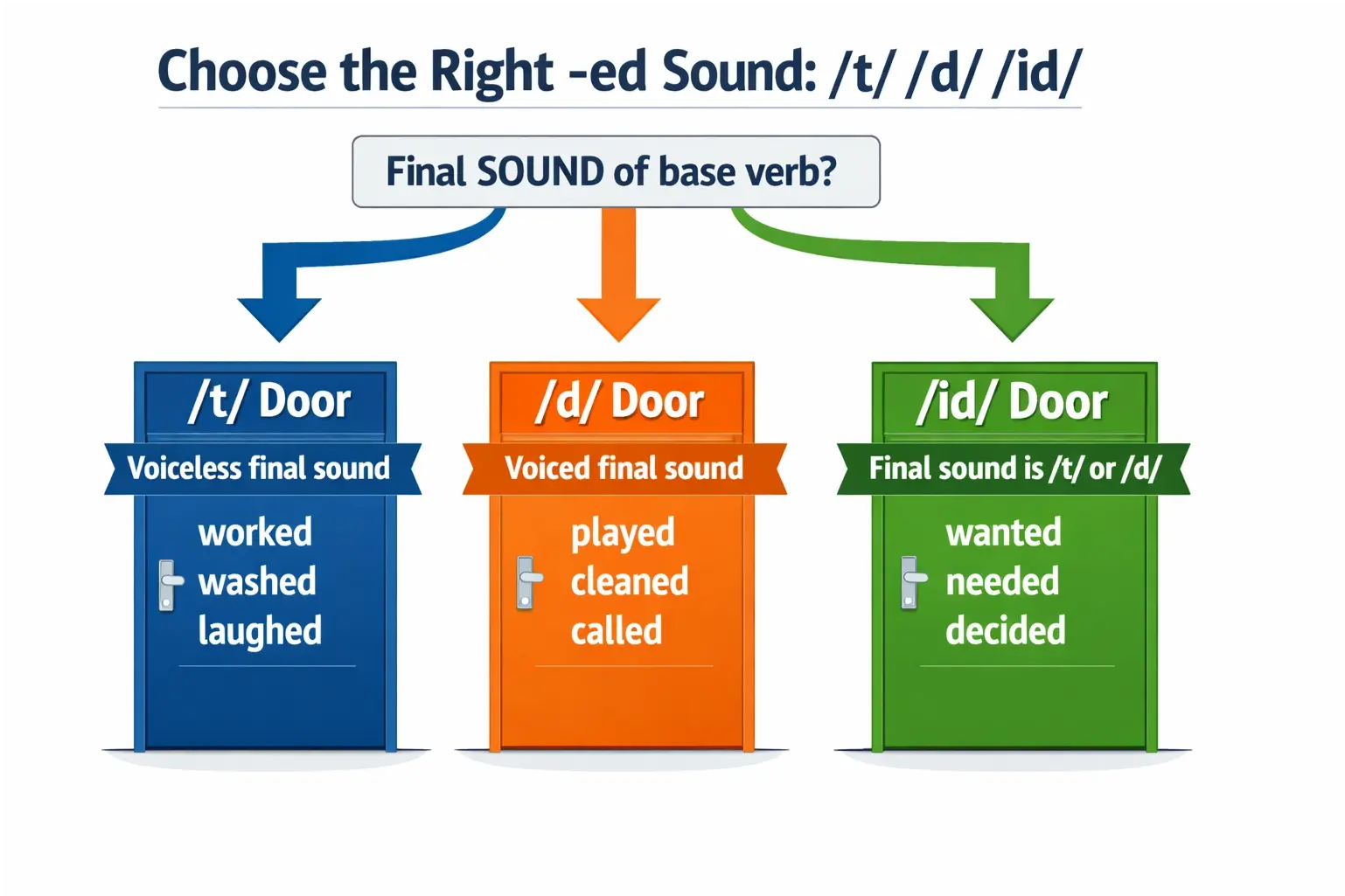
Imagine three doors in front of you. The final sound of the base verb is your key. If you listen to that final sound correctly, you always open the right door.
This topic is extremely high-impact because past tense appears in almost every story, meeting update, interview answer, and daily conversation. If your -ed endings are unstable, listeners may still understand your message, but your fluency score and clarity impression can drop. The good news is that this is rule-based. You do not need to memorize hundreds of random exceptions to make big progress.
-ed Decision Chart
Rule With Examples
The rule depends on the final sound of the base verb, not the final letter on the page.
- Use /t/ after voiceless sounds: worked, washed, laughed.
- Use /d/ after voiced sounds: played, cleaned, called.
- Use /id/ after /t/ or /d/: wanted, needed.
Quick memory analogy: quiet endings -> /t/, voiced endings -> /d/, and /t/ or /d/ endings -> /id/ because your mouth needs an extra syllable to separate similar sounds.
Why Learners Struggle
Many learners read spelling literally and pronounce every -ed as "ed". Spoken English is sound-driven, not spelling-driven.
Another common challenge is speed pressure. In controlled practice, learners can choose the correct ending. In real conversation, the brain prioritizes message and grammar, then pronunciation gets rushed. The fix is to automate the sound decision with repeated pattern drills.
Reference Sound Table
Detailed Sound Map (With Common Verbs)
Use this map to train automatic recognition. Read each verb pair aloud and exaggerate the final sound.
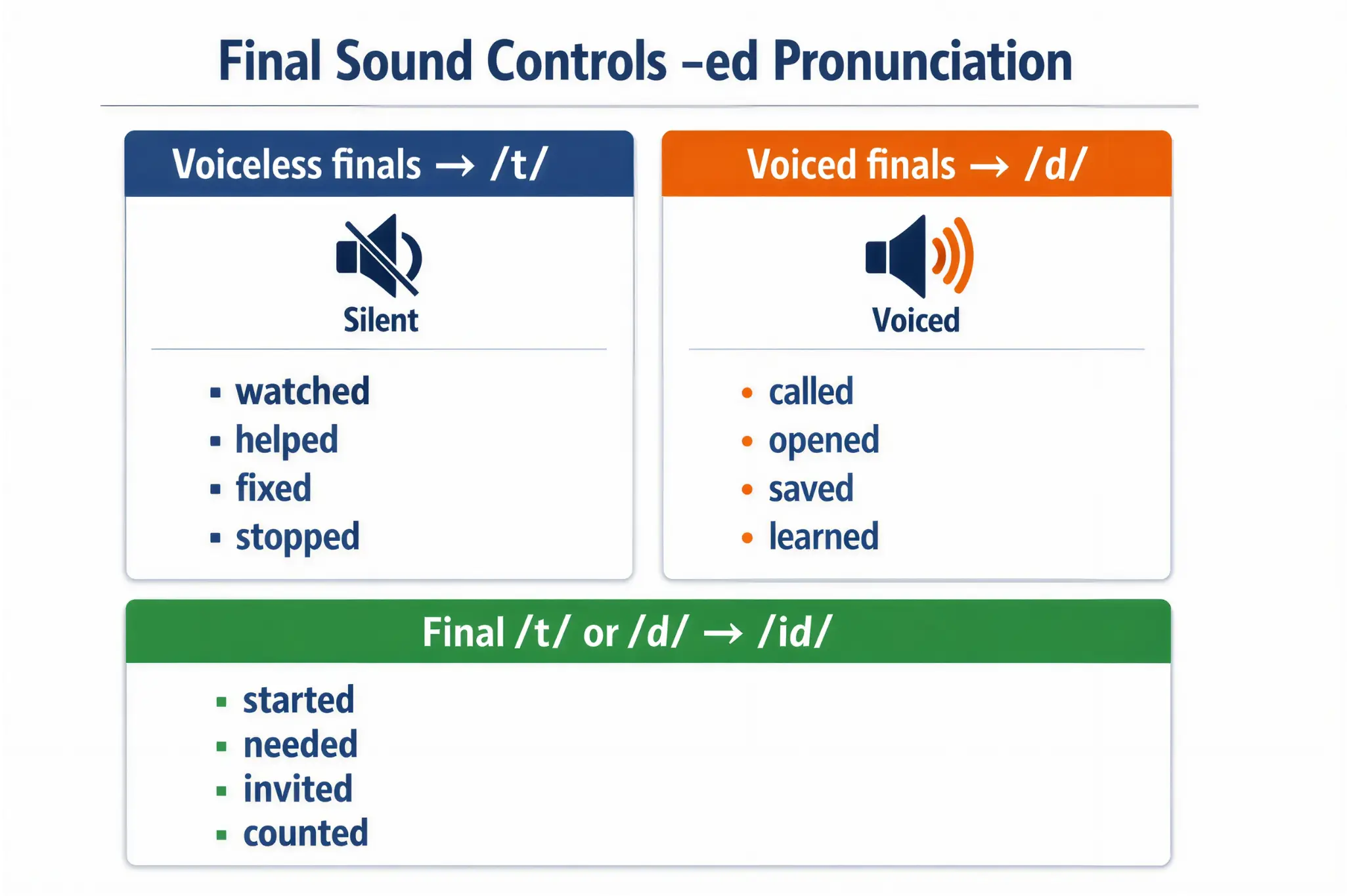
/t/ ending examples: worked, watched, helped, missed, fixed, laughed, pushed, booked, cooked, stopped.
/d/ ending examples: played, cleaned, called, opened, saved, moved, learned, listened, answered, followed.
/id/ ending examples: wanted, needed, decided, invited, painted, started, ended, repeated, counted, landed.
If you are unsure, isolate the base verb first. Example: "watch" ends in a voiceless sound, so "watched" uses /t/. "call" ends in a voiced sound, so "called" uses /d/. "need" ends in /d/, so "needed" adds /id/.
Sentence Examples You Can Reuse in Real Life
Practice these in three speeds: slow, natural, and presentation speed.
- I worked late, then watched a short video.
- She called the client and saved the file.
- We wanted faster results, so we started earlier.
- They missed the bus but arrived on time.
- He invited the team and organized the agenda.
Speak each sentence once for accuracy, once for rhythm, and once for emotional tone. Real communication requires all three.
Common Error Patterns by Habit
Always saying /id/: "work-id" instead of "worked." This creates unnatural extra syllables.
Always saying /d/: "watchd" with voiceless roots sounds unclear or heavy.
Dropping the ending completely: saying "I watch" when you mean past tense can cause grammar confusion.
Overthinking in conversation: pausing too long to choose the ending breaks fluency.
How to Pronounce the Word Elements in Real-Time
To intuitively pronounce regular past tense markers during fluid conversations, you must shift your perspective away from individual characters. If you train yourself to analyze structural boundaries, you will know exactly how to pronounce the word strings seamlessly based on physical voice tract rules rather than structural guesswork.
Isolating final phonemes on QuickPronounce before appending a past marker is an exceptional strategy. Real-time verification ensures you don't default to unnatural syllable additions when speaking under conversational velocity.
How to Automate the Rule in 14 Days
Use this two-week system if your goal is reliable habit formation.
- Days 1 to 3: train only /t/ verbs with word and sentence drills.
- Days 4 to 6: train only /d/ verbs.
- Days 7 to 9: train only /id/ verbs.
- Days 10 to 12: mixed drills with random verb lists and short stories.
- Days 13 to 14: spontaneous speaking task about yesterday, last week, and your last project.
Keep each session short and measurable. Five to ten minutes daily is enough when you practice with intent.
Fast Practice Set
- Sort 12 verbs into /t/, /d/, /id/ columns.
- Read each column aloud as a rhythm drill.
- Build one sentence per verb in past tense.
- Record and compare with dictionary audio.
- Repeat the weak category from your recording twice more.
- Use three verbs in a real story from your day.
Micro Test
Say these naturally and check yourself:
- I watched a movie yesterday.
- She cleaned the kitchen early.
- We wanted more practice.
Now create your own test with six verbs from your work or studies. Custom vocabulary increases transfer to real conversations.
Fluency Upgrade: Blend -ed Endings Into Rhythm
Pronouncing -ed correctly is step one. Step two is blending those words into natural sentence rhythm. Example: "I watched it" should flow, not sound like two disconnected words. Practice linking across word boundaries after you master the ending category.
First learn the correct gear in a car, then learn smooth gear changes. Ending selection is the gear. Sentence rhythm is the gear change.
FAQ
Is this rule always correct?
For regular past verbs, yes. Irregular verbs are a separate set and must be learned individually.
Should I prioritize grammar or pronunciation first?
Train both together. Use simple past-tense speaking tasks while applying the sound rule.
How can I self-correct quickly?
Record short daily summaries about your day. Circle every regular past verb and check each ending category.
Extended Workshop: From Rule Knowledge to Automatic Speech
Most learners understand the three -ed categories after one lesson, but real progress comes from automatic use under pressure. To build automation, combine four modes: recognition, repetition, sentence transfer, and spontaneous storytelling. Recognition means hearing the final sound of the base verb instantly. Repetition means drilling each category in rhythm blocks. Sentence transfer means using target verbs in realistic sentences. Spontaneous storytelling means speaking freely while still applying the rule.
Use this sequence in a 20-minute workshop. Minutes 1 to 5: recognition warm-up. Read base verbs and say which category their past form should follow. Minutes 6 to 10: category drill in columns (/t/, /d/, /id/). Minutes 11 to 15: sentence weaving, where you create quick original sentences using assigned verbs. Minutes 16 to 20: one-minute stories about yesterday, then peer or self review with a checklist.
If you teach or coach others, group practice works well with role cards such as "project update," "travel story," or "problem solved today." Each card forces past tense usage naturally. The speaker focuses on message first and sound second. The reviewer notes only -ed accuracy and rhythm, not grammar perfection or vocabulary level.
Another helpful strategy is contrastive pair drills. Example pair: "I watched" versus "I wanted." Learners can hear and feel the difference between /t/ and /id/ more clearly when two categories are practiced side by side. Repeat each pair in short phrase frames such as "I ___ yesterday," "We ___ this morning," and "They ___ last week."
Final tip: keep data on yourself. Track the number of past-tense verbs you used correctly in each recording. A simple score like 12 out of 15 gives motivation and objective feedback. When you measure progress, confidence grows faster and accuracy becomes reliable.
Real-World Integration: Interviews, Meetings, and Storytelling
To lock in your progress, attach -ed training to speaking scenarios you actually use. For interviews, rehearse answers to questions like "Tell me about a challenge you solved" and "Describe a project you completed." These naturally require regular past verbs. For meetings, practice a one-minute status update each day using yesterday's actions. For informal conversation, summarize your weekend in six sentences and highlight all regular past verbs.
Build a three-layer script for each scenario. Layer one is slow and careful speech for technical accuracy. Layer two is natural speed for realistic rhythm. Layer three is confident delivery with eye contact and meaning focus. Many learners stop at layer one and wonder why fluency does not transfer. Layer three is where automation is tested.
If you work with a partner, use immediate feedback tags: say "category" when the ending category is wrong and "rhythm" when the ending is technically correct but disconnected from sentence flow. This two-tag system keeps corrections fast and specific. Over time, the number of interruptions drops, and your speech becomes both more accurate and more natural.
Finally, revisit the same scenario after two weeks and compare your two recordings. Most learners are surprised by the improvement. The biggest gain is usually not perfection on every verb. It is reduced hesitation. When hesitation decreases, confidence rises, and your overall speaking performance improves in a way listeners notice immediately.
Final Takeaway
-ed endings look small on the page, but they strongly affect how clear and confident your English sounds. Use the three-door rule, train with category drills, and move into sentence rhythm as soon as possible. Once this becomes automatic, your storytelling becomes smoother, your interview answers sound more polished, and your spoken grammar feels more reliable. Keep practicing with your own daily vocabulary so this skill transfers from drills to real communication without hesitation.
Start Practicing
Use QuickPronounce to check IPA, compare accents, and improve clarity.
Open QuickPronounce