
How to Read IPA and Pronounce English Words Correctly
On this page
- English Spelling Won't Tell You How to Say a Word
- Why Bother Learning IPA?
- How to Read a Transcription Before Touching the Symbols
- The Consonants Worth Learning
- Vowels: Where Most Pronunciation Problems Live
- What Accent Differences Actually Look Like in IPA
- How to Parse a Pronunciation in English Entry
- The Mistakes IPA Actually Helps You Fix
- Why Individual Words Aren't the Whole Picture
- How to Actually Use This
- Practice Reading IPA
- Common Questions
- Search Questions & Quick Answers
- The Short Version
English Spelling Won't Tell You How to Say a Word
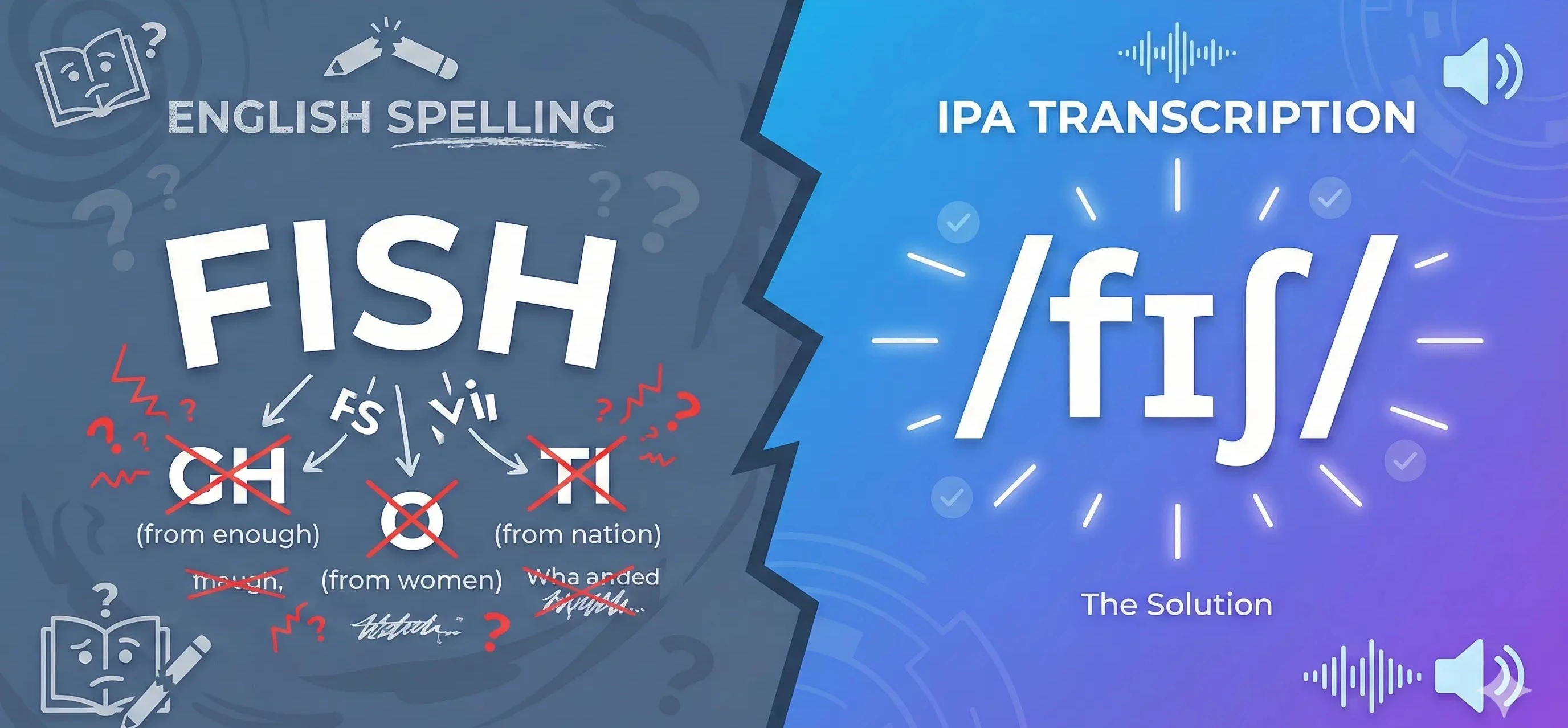
How do you pronounce the word wind? Does it rhyme with "blind" or with "sinned"? Without more context, you genuinely can't tell. That's not a trick question - it's just English spelling being English spelling.
Now try read, live, tear, or row. Each one has two completely different pronunciations depending on meaning, and the spelling gives you nothing to go on. This isn't a quirk of a few unusual words - it's the default state of English. The language borrowed so heavily from French, Latin, Old Norse, and Greek that its spelling is essentially a historical archive, not a pronunciation guide.
The International Phonetic Alphabet (IPA) was built specifically to fix this. Each symbol maps to one sound, without exception. When you see /wɪnd/ you know it rhymes with "sinned." When you see /waɪnd/ you know it rhymes with "blind." No guessing. That's the whole point.
This guide covers the symbols you'll actually encounter when looking up English words - not the full global IPA chart, which represents sounds from hundreds of languages and is genuinely not something you need to memorise.
Why Bother Learning IPA?
The honest answer: you don't have to. You can improve your pronunciation by listening carefully, mimicking native speakers, and building up intuition over time. Plenty of people do.
But IPA gives you something listening alone can't - a way to verify what you heard. When you're not sure if a word ends in /s/ or /z/, or whether a vowel is /ɪ/ or /iː/, a dictionary entry settles it immediately. You're no longer guessing from spelling or trying to remember if a native speaker swallowed that syllable.
The income stream of reliable phonetic strings helps down the line. Once you can read IPA, any dictionary becomes genuinely useful for pronunciation. You stop needing audio for every single word. And when you look up the same word in its British and American transcriptions, you can see exactly what's different and why - not just that they "sound a bit different."
IPA transcriptions in dictionaries are simplified. They show you the target sounds of a "standard" accent, not how any real person actually speaks. In connected natural speech, sounds blur, disappear, and influence each other constantly. IPA is the map, not the territory. Use it alongside audio, not instead of it.
How to Read a Transcription Before Touching the Symbols
Before you learn any symbols, understand what the marks around and between them mean. Most people skip this and then get confused.
| Mark | Name | What it means | Example |
|---|---|---|---|
| ˈ | Primary stress | The syllable immediately after this gets the main emphasis | photograph /ˈfəʊtəɡrɑːf/ - stress on FOE |
| ˌ | Secondary stress | Medium emphasis - less than primary, more than unstressed | photographic /ˌfəʊtəˈɡræfɪk/ - stress on GRAF |
| ː | Length mark | The vowel before it is held longer | /iː/ in beat vs /ɪ/ in bit |
| . | Syllable break | Separates syllables in longer words | information /ˌɪn.fəˈmeɪ.ʃən/ |
The stress mark is the one that actually changes meaning in English. REcord (noun) vs reCORD (verb). PROtest vs proTEST. PERmit vs perMIT. Getting stress wrong is the single biggest cause of miscommunication - more than individual sounds. Always find the ˈ first.
The Consonants Worth Learning
Most English consonants use symbols that look like their corresponding letters - /p/, /b/, /m/, /t/, /d/, /k/, /g/, /f/, /v/, /s/, /z/, /h/, /l/, /n/, /r/, /w/, /j/. You already know these. The ones below are the exceptions - symbols that look unfamiliar, or sounds that don't have a single letter in standard spelling.
Notice that /ŋ/ never has a /g/ after it in words like sing /sɪŋ/ or ring /rɪŋ/. But in finger /ˈfɪŋɡər/, there is a /g/. The IPA spells it out exactly - no ambiguity.
Vowels: Where Most Pronunciation Problems Live
English has around 20 vowel sounds depending on the accent. Most languages have 5 to 7. That gap is why vowel errors are so persistent - your native language simply doesn't have slots for many of these sounds, so your brain maps them onto the nearest equivalent it knows.
The good news: you don't need to perfect all 20. Most communication breakdowns come from a handful of distinctions. The /iː/ vs /ɪ/ pair causes real confusion (leave vs live). So does /æ/ vs /ɑː/ in different accents. Focus there first.
Pure Vowels (Monophthongs)
The Schwa /ə/ - English's Most Misunderstood Sound
The schwa is the single most common sound in English. It appears in the first syllable of about, the second syllable of garden, both unstressed syllables of banana. It's a completely neutral, lazy vowel - the sound your mouth makes when it's not trying.
Most learners avoid it. They give every vowel its "full" value because that feels more careful and correct. In practice, it makes you sound robotic. English rhythm is built on the contrast between stressed syllables (which carry the real vowel sounds) and unstressed ones (which collapse to /ə/). When you pronounce every syllable fully, that rhythm disappears.
| Word | Common mistake | Correct |
|---|---|---|
| about | /æbaʊt/ ✗ | /əˈbaʊt/ ✓ |
| photograph | /ˈfoʊtoʊɡræf/ ✗ | /ˈfəʊtəɡrɑːf/ ✓ |
| banana | /bæˈnænæ/ ✗ | /bəˈnɑːnə/ ✓ |
| parliament | /ˈpɑːrliæment/ ✗ | /ˈpɑːləmənt/ ✓ |
In IPA, every /ə/ is a signal: don't stress this, don't fully pronounce this. Once you train yourself to see it that way, your rhythm improves almost immediately.
Diphthongs - the Vowels That Move
A diphthong is a vowel sound that glides from one position to another within the same syllable. When you say my, your tongue starts in a low open position and moves toward the /ɪ/ position. That movement is the vowel - not a single steady sound.
The most common error with diphthongs is turning them into pure vowels. In some accents and learner varieties of English, day /deɪ/ gets pronounced as a flat /deː/. It sounds close but slightly off - native speakers notice it even when they can't explain why.
What Accent Differences Actually Look Like in IPA
One of the most useful things IPA does is show you exactly why two accents sound different - not just that they do. Here are three words that illustrate the most common systematic differences between American and British English.
dance
AmE /dæns/ - short front vowel /æ/ - bright and nasal
BrE /dɑːns/ - long back vowel /ɑː/ - open and rounded
This is the trap/bath split - one of the most systematic vowel differences between the two accents. Words like ask, path, can't, laugh all follow the same pattern.
car
AmE /kɑːr/ - rhotic - the /r/ is fully pronounced
BrE /kɑː/ - non-rhotic - the /r/ disappears before a consonant or pause
American English is rhotic - /r/ is pronounced wherever it's written. Most British, Australian, and New Zealand accents are non-rhotic. This single difference explains a huge chunk of what makes the accents sound different.
go
AmE /ɡoʊ/ - starts on a rounded mid back /o/
BrE /ɡəʊ/ - starts on a schwa /ə/ - a more central starting point
The same diphthong, but with different starting positions. This affects words like home, phone, coat, road - most of the "long o" words in English.
How to Parse a Pronunciation in English Entry
If your core milestone is evaluating how standard lexical items behave contextually, reading a pronunciation english roadmap gives you the code parameters layout before audio rendering occurs. If you encounter a complex character map and need to check how to pronounce in english smoothly, isolating syllables helps you master inflection points perfectly.
Testing these terms inside the core parser layout ensures your vocal execution matches native outputs safely across any selected geographical layout option without tracking unexpected syllable bugs.
The Mistakes IPA Actually Helps You Fix
These aren't abstract errors from a textbook. They're the specific sound confusions that IPA makes visible - and fixable.
/iː/ vs /ɪ/ - not just length
/θ/ and /ð/ - the physical problem
Stress: the mistake that actually breaks communication
Fully pronouncing function words
Why Individual Words Aren't the Whole Picture
IPA transcriptions in dictionaries show words in isolation. Real speech doesn't work that way. When words run together, sounds at word boundaries change, disappear, or influence each other. This is called connected speech and it's why fast native speech sounds so different from the individual words you've been practising.
Linking
Elision
Assimilation
Weak forms
How to Actually Use This
The goal isn't to memorise the IPA chart. It's to be able to look up any word and extract useful information from its transcription. That takes about a week of regular practice to get comfortable with.
- Find the stress mark first. Before you decode any vowels, locate ˈ. That syllable is your anchor - everything else in the word is lighter.
- Count the schwas. Every /ə/ in the transcription is a syllable you should be reducing. How many does the word have? More than you expected is usually the honest answer.
- Compare accents side by side. Use QuickPronounce to see the IPA for AmE and BrE at the same time. The differences are visible, not just audible - you can see exactly which vowel changed.
- Say it once with the IPA in front of you. Then play the audio. If what you said and what you heard match, the symbols worked. If they don't, the symbol you got wrong is the one to focus on.
Practice Reading IPA
Quick practice
Test your IPA recognition with a short quiz
You've seen how to decode stress marks, vowels, and consonants. Now check how much of it stuck by matching real words to their IPA transcriptions under a timer.
Take the IPA quiz →Common Questions
Do I need to learn every IPA symbol?
No. For English, focus on the symbols you'll actually encounter. Start with the ones that don't exist in your native language - those are the gaps causing your accent. The rest you'll learn passively as you look up words.
Different dictionaries show different IPA for the same word. Which is right?
Both, usually. They're targeting different accents, or using slightly different conventions. Cambridge typically transcribes British RP. Merriam-Webster transcribes General American. Neither is more "correct" - they're just different accents. QuickPronounce shows you both, with audio, so you can decide which accent you're aiming for.
Can IPA replace listening to native speakers?
No, and it shouldn't try to. IPA tells you what sounds to aim for. Audio tells you what those sounds actually feel like and how they shift in real speech. One Ace Linguist post put it well: "write what you heard, not what you think you heard." Use IPA to understand what you're aiming for, use audio to calibrate.
How long before IPA stops feeling slow and effortful?
For most people, 2–3 weeks of regular use. The vowel symbols take longest - the consonants click into place faster because many look like regular letters. The schwa /ə/ is usually the last thing to become automatic, because it appears so often and the temptation to over-pronounce it never fully goes away.
Search Questions & Quick Answers
How do I read IPA for a single word?
Find the primary stress mark (ˈ) first, count schwas (/ə/), then decode vowel symbols. Use audio to confirm what the symbols indicate.
Where can I hear IPA examples with audio?
Use QuickPronounce to see IPA alongside audio in multiple accents - it pairs the transcription with real audio so you can hear the symbol in context.
Will learning IPA help me pronounce names and brands?
Yes. IPA removes guessing for non-phonetic spellings and helps you spot stress and vowel quality even for unusual words.
Where can I get pronunciation audio alongside IPA?
Use QuickPronounce to view IPA with synchronized audio in multiple accents. It's a quick way to compare how a symbol sounds across dialects and confirm transcription accuracy.
The Short Version
If you're writing an app or a browser extension that needs IPA, syllable stress, and pronunciation audio as data, the QuickPronounce API returns all of it as JSON for 116,000+ words. Free while in public testing, one API key by email.
English spelling will not help you pronounce English words. IPA will. The symbols are not mysterious once you know that most of them look exactly like regular letters, and the ones that don't are there precisely because no existing letter could do the job.
Find the stress mark first. Look for the schwas. Notice where your accent's transcription differs from the target. Listen to the audio to calibrate. Repeat with the next word.
That's the loop. It gets faster quickly.
Get pronunciation as you read: the QuickPronounce extension works on any page, not just this one.
Add to ChromeSee IPA in action
Type any word into QuickPronounce and get the IPA transcription for four English accents, with audio.
Try QuickPronounce