
How to Pronounce American vs British English: 4 Core Sound Rules
On this page
Why the Gap Is Smaller Than You Think
This comparison pairs well with live audio on QuickPronounce, so try listening to the same word in both accents to hear the differences discussed below.
The funny thing about American and British English is that the gap between them is smaller than most learners think and also stranger. It is not random drift. Just four phonetic shifts, most traceable to specific centuries, explain much of what your ear notices. Once you see the pattern, you stop memorizing exceptions and start predicting them.
This guide focuses on General American (GenAm) and Received Pronunciation (RP), the reference accents commonly used in international business, broadcast media, and language education. If someone is from Boston or Glasgow, different patterns may apply, but these two accents remain the baseline that much of the world learns and navigates from.
Do not try to memorize individual words. Focus on the four rules below and you will be able to predict how thousands of words differ, including words you have never seen before.
Search Questions & Quick Answers
How should I compare American vs British pronunciations?
Listen to the same word in both accents on QuickPronounce, note vowel and /r/ differences, then practice the variant matching your target context.
Will accent differences change meaning?
Not usually. Most differences are accentual, not lexical, but stress or vowel changes can occasionally affect recognition.
🗣️ The 4 Fundamental Sound Differences
About 90% of the pronunciation differences between American and British English trace back to just four phonetic rules. Tap through each one below, then drill the example words.
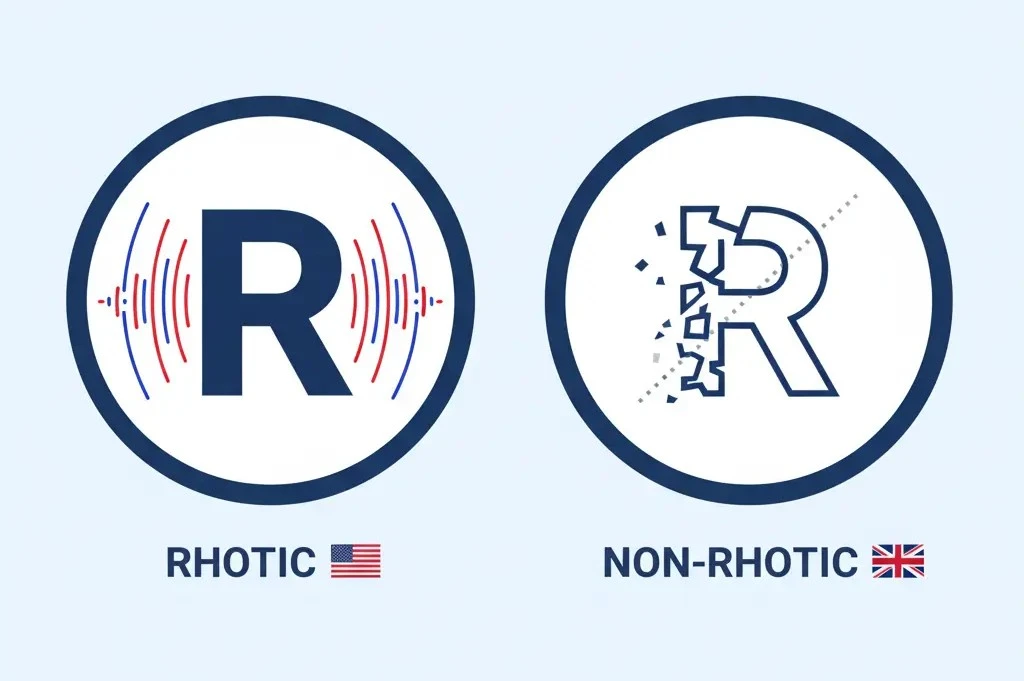
Rhotic vs. non-rhotic /r/
American English pronounces every /r/ you see written. British RP drops it after a vowel unless the next word starts with a vowel too. That's it. This one rule cascades across hundreds of words - and it's why British speech has those long, open vowels that Americans mistake for 'posh.'
Tap a word to see the breakdown
📚 12 Words That Change Dramatically
These words demonstrate multiple sound differences at once, which is exactly what makes them challenging. They are grouped by the type of change so the patterns are easier to spot.
| Word | American (AmE) | British (BrE) | What changed |
|---|---|---|---|
| Aluminum/Aluminium | ə-ˈluː-mə-nəm | ˌæl-jə-ˈmɪn-i-əm | Different spelling AND pronunciation - BrE adds a whole extra syllable. |
| Schedule | ˈskedʒ-uːl | ˈʃedʒ-uːl | AmE uses /sk/, BrE uses /ʃ/ (the 'sh' sound). |
| Tomato | tə-ˈmeɪ-toʊ | tə-ˈmɑː-təʊ | The vowel in the second syllable is completely different. |
| Herb | ɜːrb | hɜːb | AmE drops the /h/; BrE pronounces it clearly. |
| Route | ruːt / raʊt | ruːt | AmE allows two pronunciations; BrE uses only one. |
| Lieutenant | luː-ˈten-ənt | lef-ˈten-ənt | The first syllable is completely different in BrE - 'lef' not 'loo'. |
| Advertisement | ˌæd-vər-ˈtaɪz-mənt | əd-ˈvɜː-tɪs-mənt | Stress falls on different syllables entirely. |
| Privacy | ˈpraɪ-və-si | ˈprɪv-ə-si | Long 'i' vs short 'i' in the first syllable. |
| Garage | ɡə-ˈrɑːʒ | ˈɡær-ɑːʒ | AmE stresses the second syllable; BrE stresses the first. |
| Figure | ˈfɪɡ-jər | ˈfɪɡ-ə | Classic rhotic vs non-rhotic difference. |
| Leisure | ˈliː-ʒər | ˈleʒ-ə | Different vowel sounds in the first syllable. |
| Vase | veɪs | vɑːz | Long 'a' vs 'ah' - and AmE uses /s/ where BrE uses /z/. |
🎧 Interactive Sound Breakdown & Accent Practice
To truly refine your accent pronunciation, you must master how individual vowels interact with regional voice constraints. Isolating the distinct pronunciation sound profiles between regions makes target speech listening significantly more predictable.
Comparing Vowel & Accent Variations
When drilling your targets, listen specifically to how a us pronunciation sound relies on open back vowels, whereas standard british accent pronunciation audio configurations focus on tightly rounded lip shapes or drop the trailing rhotic /r/ entirely.
Tip: Use the search box at the top of QuickPronounce to test secondary terms alongside these core modules to map subtle audio differences yourself.
🎯 How to Practice Effectively
Step 1: One rule at a time
Step 2: Use minimal pairs
Step 3: Shadow native speakers
Step 4: Record yourself
With 15 to 20 minutes of focused daily practice, most learners can reliably distinguish and produce both accents within 2 to 3 months. Prioritize recognition first because production often follows naturally once your ear catches up.
🧪 Practice the 4 Rules
Quick practice
Test yourself with an American vs British quiz
You've seen the rhotic /r/, the TRAP-BATH split, T-flapping, and the LOT vowel. Now put them to work: listen to real American and British audio, match words to IPA, and spot spelling and vocabulary differences, level by level through all four rules.
Take the American vs British quiz →🌍 Beyond the Standard Accents
English has been fragmenting regionally for centuries. The two standard accents in this guide are reference points, not the whole picture. A few variations worth knowing about:
Notable American variations
- New York City: Older speakers are often non rhotic. The "pahk the cah" stereotype belongs here as much as it does to Boston. The accent also features distinctive vowel shifts in words like "coffee."
- Southern States: Longer vowels, distinctive diphthongs, and the pin pen merger, where /ɪ/ and /ɛ/ merge before nasal consonants.
- Boston: Non rhotic like RP and one of the few American dialects to drop the /r/.
- AAVE: Features systematic grammatical and phonological patterns and has had a significant cultural influence on mainstream American English.
Notable British variations
- Cockney (East London): Features th fronting, where /θ/ becomes /f/, glottal stops that replace /t/, and rhyming slang. For example, "water" may become "wa'er."
- Scottish English: Rhotic, like General American, meaning Scottish speakers usually keep their /r/ after vowels.
- Northern England: Uses /æ/ in BATH words, just like many American accents. The TRAP BATH split is mainly a Southern English feature rather than a British wide one.
- Welsh English: Features distinctive intonation patterns and some consonant differences influenced by Welsh.
Start with GenAm or RP because they are the most widely understood accents internationally. Regional varieties become easier to understand once you have a reference point for comparison.
❓ Common Questions
Which accent should I learn as a non-native speaker?
Follow your input. If you mostly watch American TV and plan to work in the US, American English is the obvious choice because you will already be absorbing it passively. For British, Australian, or many European professional contexts, RP may be more useful. Both are widely understood globally, and consistency matters more than the accent you choose.
Can I mix American and British pronunciation?
It happens, especially with learners, but it can create friction. The issue is not correctness but predictability. Listeners usually adjust to your accent within the first few seconds. Switching accents during a conversation can make comprehension more difficult. Aim for consistency within whichever accent you are practicing.
Why does spelling differ (color/colour, realize/realise)?
Noah Webster deliberately reformed American spelling in the early 1800s to make it more phonetic and to give the new country a distinct linguistic identity. British spelling had already begun standardizing in a different direction. The two systems then developed separately, while pronunciation and spelling continued to evolve independently.
Do native speakers always follow these rules?
The rules describe standard accents and apply to the vast majority of speakers in each variety. However, region, age, education, and social context all contribute to variation. Think of them as reliable defaults with predictable exceptions rather than universal laws.
Get pronunciation as you read: the QuickPronounce extension works on any page, not just this one.
Add to ChromeReady to Master Both Accents?
Use QuickPronounce to hear side-by-side comparisons in American, British, Australian, and Indian English with IPA transcriptions.
Try QuickPronounce Now