
How to Pronounce Confusing English Sounds with Minimal Pairs
On this page
- What Are Minimal Pairs and Why Do They Matter So Much?
- Sound-Contrast Map: Minimal Pair Families
- The 6 Highest-Impact Contrasts to Train First
- Listening First, Then Speaking: The Correct Order
- Example Bank: 40 Minimal Pairs You Can Reuse
- Mouth Position Guide for Difficult Contrasts
- Real-Life Sentences That Force Clear Contrasts
- Leveraging Pronunciation Voice Tools for Minimal Pairs
- 30-Day Minimal Pairs Plan (Simple and Repeatable)
- Common Mistakes and How to Avoid Them
- Practice the Contrasts
- Final Takeaway: Precision Builds Confidence
- Search Questions & Quick Answers
What Are Minimal Pairs and Why Do They Matter So Much?
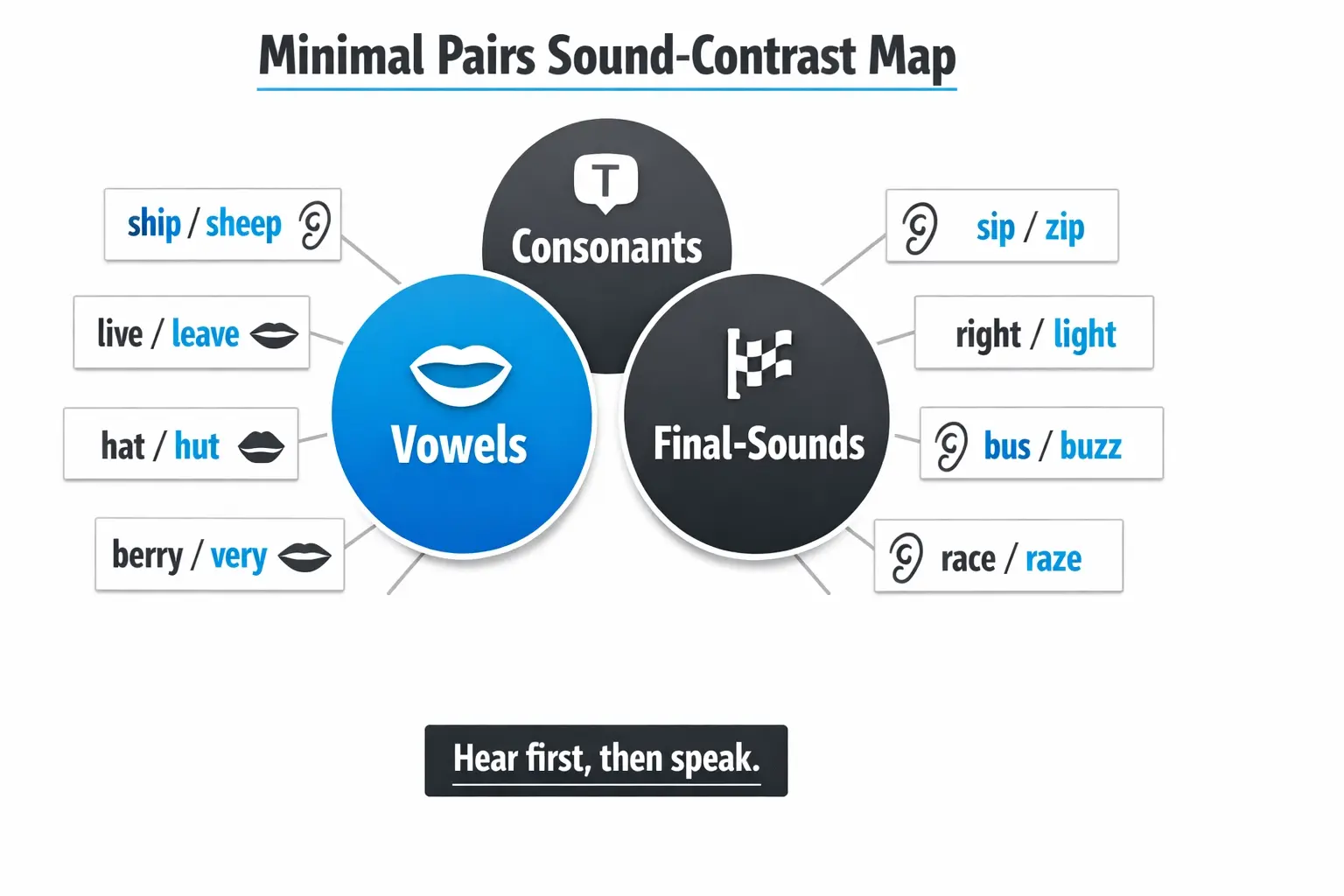
Minimal pairs are two words that differ by only one sound, like ship/sheep, live/leave, or fan/van. That one-sound difference may look small, but in conversation it can change meaning completely.
If word stress is the rhythm engine of speech, minimal pairs are the precision controls. They improve your ability to hear tiny sound differences and produce them clearly under real speaking pressure.
Think of pronunciation like tuning a guitar. If one string is even slightly out of tune, the whole chord sounds off. Minimal-pair training tunes those "strings" one by one so your speech sounds clear and accurate.
Learners often focus on grammar first and sound details later. That is understandable, but it creates a gap: grammatically correct sentences that still confuse listeners. Minimal pairs close that gap quickly.
Sound-Contrast Map: Minimal Pair Families
The 6 Highest-Impact Contrasts to Train First
You do not need 100 contrasts on day one. Start with the ones that cause most communication breakdowns.
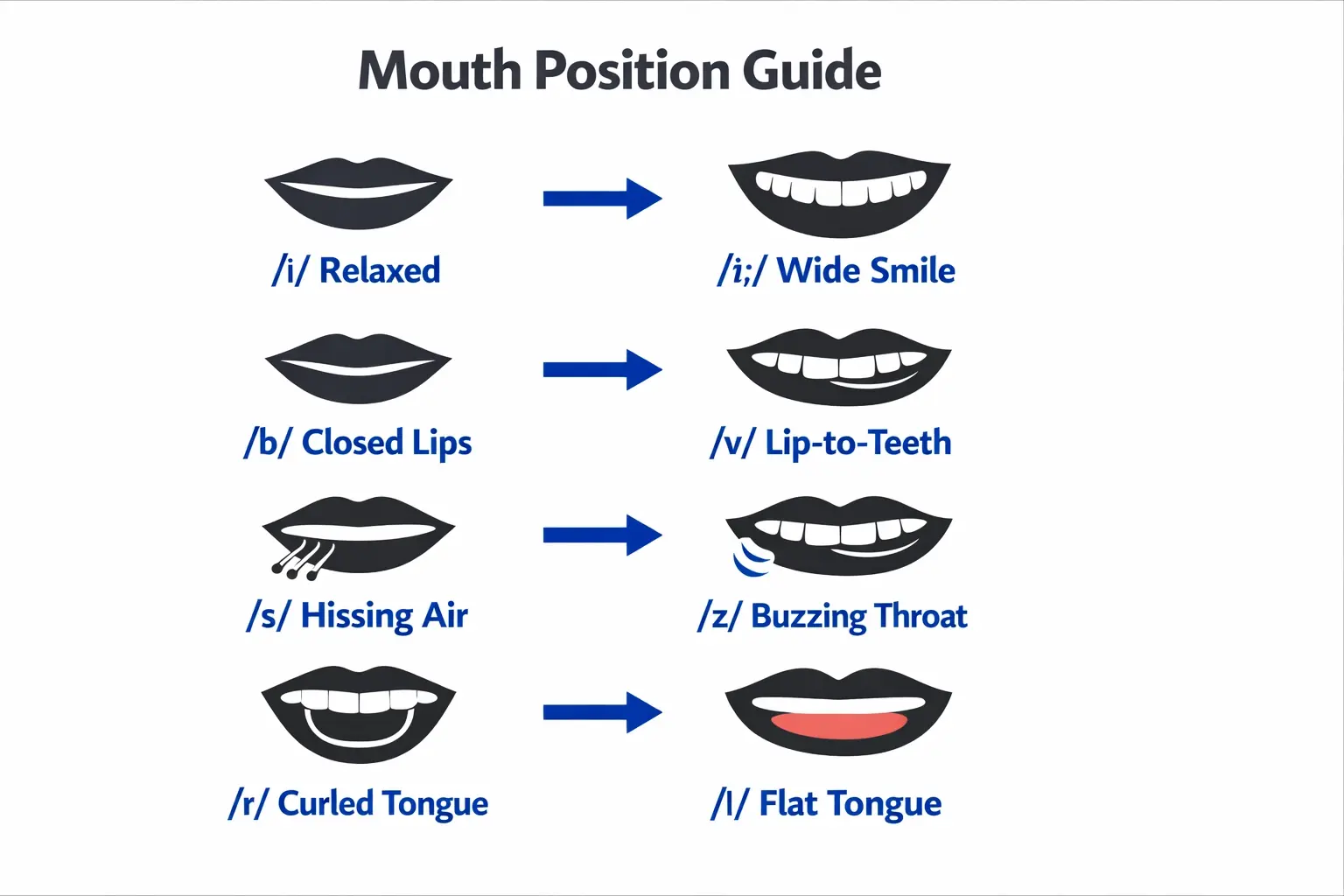
- /ɪ/ vs /iː/ - ship/sheep, live/leave, sit/seat
- /æ/ vs /ʌ/ - hat/hut, cap/cup, bad/bud
- /e/ vs /æ/ - men/man, pen/pan, bed/bad
- /b/ vs /v/ - berry/very, ban/van, best/vest
- /s/ vs /z/ - sip/zip, bus/buzz, race/raze
- /r/ vs /l/ - right/light, road/load, glass/grass
These contrasts appear in common daily vocabulary, so they give fast, visible gains. You can immediately apply them in calls, meetings, classes, and interviews.
Listening First, Then Speaking: The Correct Order
A common mistake is trying to produce a sound before hearing the difference clearly. If your ear cannot detect the contrast reliably, your mouth will guess.
Use this order:
- Discrimination - hear two words and identify which one you heard.
- Imitation - repeat after a clear model.
- Controlled production - read minimal pair lists.
- Sentence transfer - use both words naturally in context.
- Spontaneous transfer - use target words in free speech.
This is like sports training. You do not jump straight into a full match. You train individual movements first, then combine them.
Example Bank: 40 Minimal Pairs You Can Reuse
Vowel Contrasts
- ship / sheep
- live / leave
- sit / seat
- bit / beat
- full / fool
- pull / pool
- hat / hut
- cap / cup
- bad / bud
- man / men
- pan / pen
- bat / bet
- walk / work
- cot / caught
- luck / lock
- cut / coat
- fan / fun
- bad / bed
- mat / met
- cup / cope
Consonant Contrasts
- berry / very
- ban / van
- boat / vote
- sip / zip
- bus / buzz
- ice / eyes
- right / light
- road / load
- glass / grass
- fan / pan
- pear / bear
- cheap / jeep
- ten / den
- coat / goat
- thin / sin
- thank / sank
- then / den
- chin / shin
- joke / choke
- rice / rise
Mouth Position Guide for Difficult Contrasts
Real-Life Sentences That Force Clear Contrasts
Isolated words are useful, but sentence-level drills create transfer. Read each pair aloud and exaggerate contrast on your first two rounds.
- "The ship is late." / "The sheep is calm."
- "I live near the station." / "Please leave early."
- "That man is my manager." / "Those men are engineers."
- "I need a berry smoothie." / "This is a very good idea."
- "Turn right at the bank." / "Turn on the light please."
- "It is a thin line." / "Please sin less in this sentence game."
Yes, a few sample sentences are intentionally simple. Simplicity is a feature, not a weakness. You are training precision, not creativity, in this stage.
Leveraging Pronunciation Voice Tools for Minimal Pairs
It is crucial to listen to real audio examples to learn how words are actually pronounced. When your brain processes complex acoustic signals, listening closely to a neutral pronunciation voice stream on QuickPronounce removes spelling ambiguity completely, ensuring you map similar vowel targets smoothly without vocal friction.
Isolating your weakest consonant pairings and drilling them against live audio output arrays allows you to self-correct before motor adjustments are fully automated during spontaneous speaking situations.
30-Day Minimal Pairs Plan (Simple and Repeatable)
Week 1: Ear Training Foundation
Focus on 2 contrasts only. Run 10 minutes per day: 5 minutes listening discrimination, 5 minutes repetition. Goal: 80% listening accuracy.
Week 2: Controlled Production
Keep the same contrasts and add sentence practice. Record short clips and compare. Goal: clear contrast in scripted sentences.
Week 3: Expansion
Add two new contrasts while maintaining old ones. Alternate days: listening day, speaking day. Goal: stability under mild complexity.
Week 4: Real Transfer
Use target words in interviews, role-play, and spontaneous monologues. Goal: natural use without reading from notes.
Common Mistakes and How to Avoid Them
Too many contrasts at once. Fix by training 1–2 pairs per week.
Practicing only with lists. Fix by adding sentence drills from day 3.
No feedback loop. Fix by recording every 2–3 days.
Ignoring stress and rhythm. Fix by combining this plan with word stress training.
Perfection mindset. Aim for intelligibility first, not accent perfection.
Practice the Contrasts
Quick practice
Test your ear with a minimal pairs quiz
Reading about ship/sheep and live/leave is one thing - hearing them without the spelling in front of you is the real test. Try a timed round and see how your discrimination holds up.
Take the Minimal Pairs quiz →Final Takeaway: Precision Builds Confidence
Minimal-pair training is one of the most practical pronunciation strategies because it attacks confusion at the source: sound contrast. Better contrast improves listening, speaking, and confidence at the same time. It is not flashy, but it is high return.
Keep your process focused: train a small set, repeat consistently, transfer into real sentences, and track progress with recordings. Over a month, small daily gains become obvious changes in clarity. That is exactly the kind of progress that listeners notice and trust.
Search Questions & Quick Answers
Does minimal pairs training need special tools?
No; you can practice with audio from QuickPronounce or simple recorded examples, but the key is consistent discrimination and feedback.
How many minutes per day?
Ten to fifteen focused minutes is enough when done consistently with recording and review.
Start Practicing
Use QuickPronounce to check IPA, compare accents, and improve clarity.
Open QuickPronounce