
How to Pronounce 'The' Correctly: /ðə/ vs /ðiː/ Rule
On this page
- Why This Tiny Word Creates Big Confusion
- The Core Rule (Simple Version)
- Decision Guide: When to Say /ðə/ or /ðiː/
- Analogy: Think of It Like a Door Hinge
- High-Value Example Sets (By Situation)
- Sound-First Exceptions Learners Often Miss
- When Speakers Use /ðiː/ for Emphasis
- Rhythm Comparison: /ðə/ vs /ðiː/ in Natural Speech
- Practice Ladder: From Rule to Natural Habit
- Common Errors and Quick Fixes
- Practice What You've Learned
- Frequently Asked Questions
- Final Takeaway: Tiny Rule, Big Clarity Gain
Why This Tiny Word Creates Big Confusion
"The" is one of the most frequent words in English, which makes its pronunciation surprisingly important. Learners often ask: "Should I say thuh or thee?" If the rule feels random, you are not alone.
The reason this matters is rhythm. Because "the" appears everywhere, small pronunciation choices affect how natural your entire sentence sounds. Using the wrong version occasionally is not a disaster, but repeated mismatch can make speech feel less smooth.
Good news: the core rule is simple and highly practical. You can learn it in minutes and automate it with short daily practice.
The Core Rule (Simple Version)
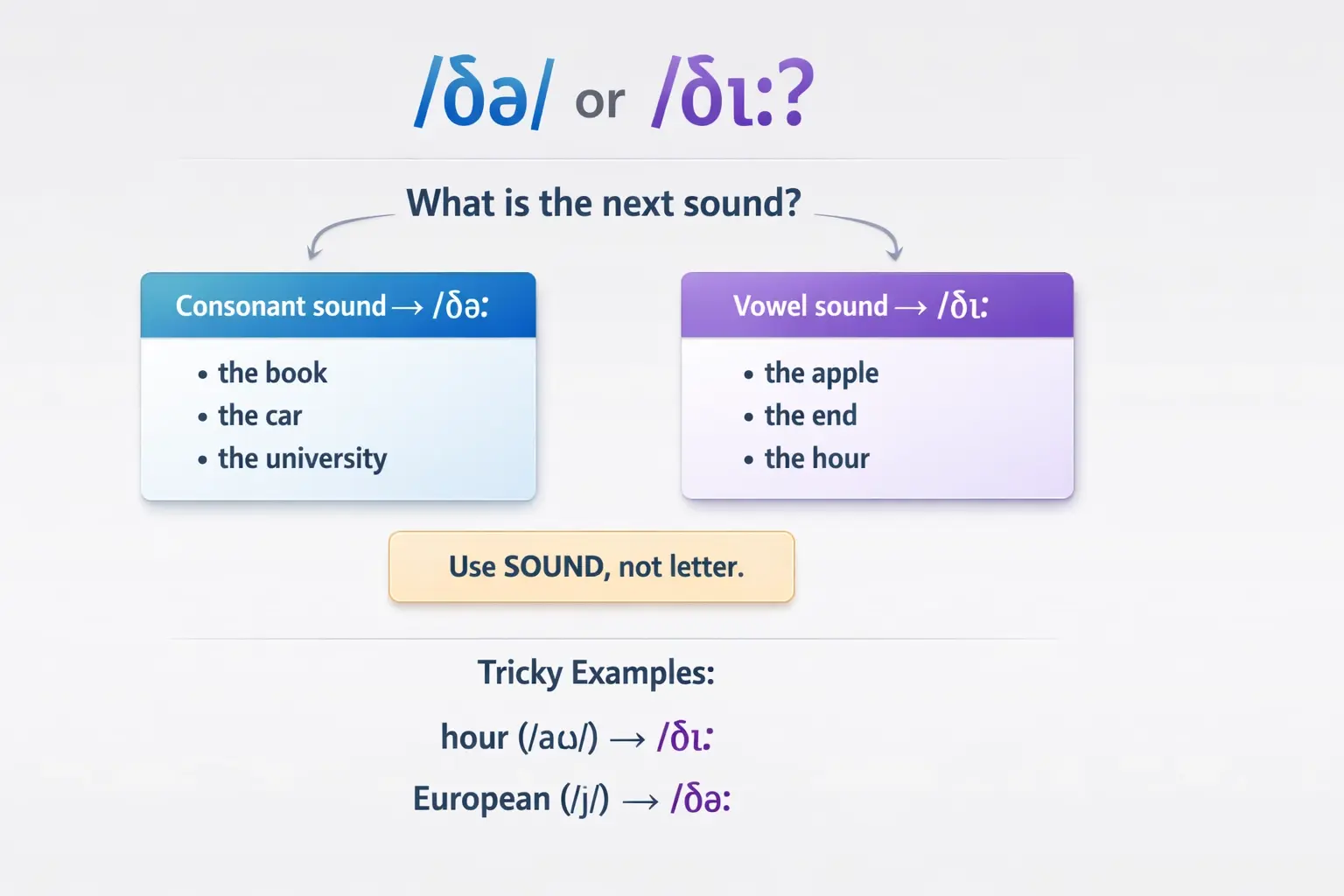
- Use /ðə/ ("thuh") before a consonant sound: the book, the car, the problem.
- Use /ðiː/ ("thee") before a vowel sound: the apple, the end, the office.
Notice the keyword: sound, not letter. If a word starts with a vowel letter but consonant sound (like "university" with /juː/), you often use /ðə/: the university. If a word starts with consonant letter but vowel sound (like "hour"), you use /ðiː/: the hour.
Decision Guide: When to Say /ðə/ or /ðiː/
Analogy: Think of It Like a Door Hinge
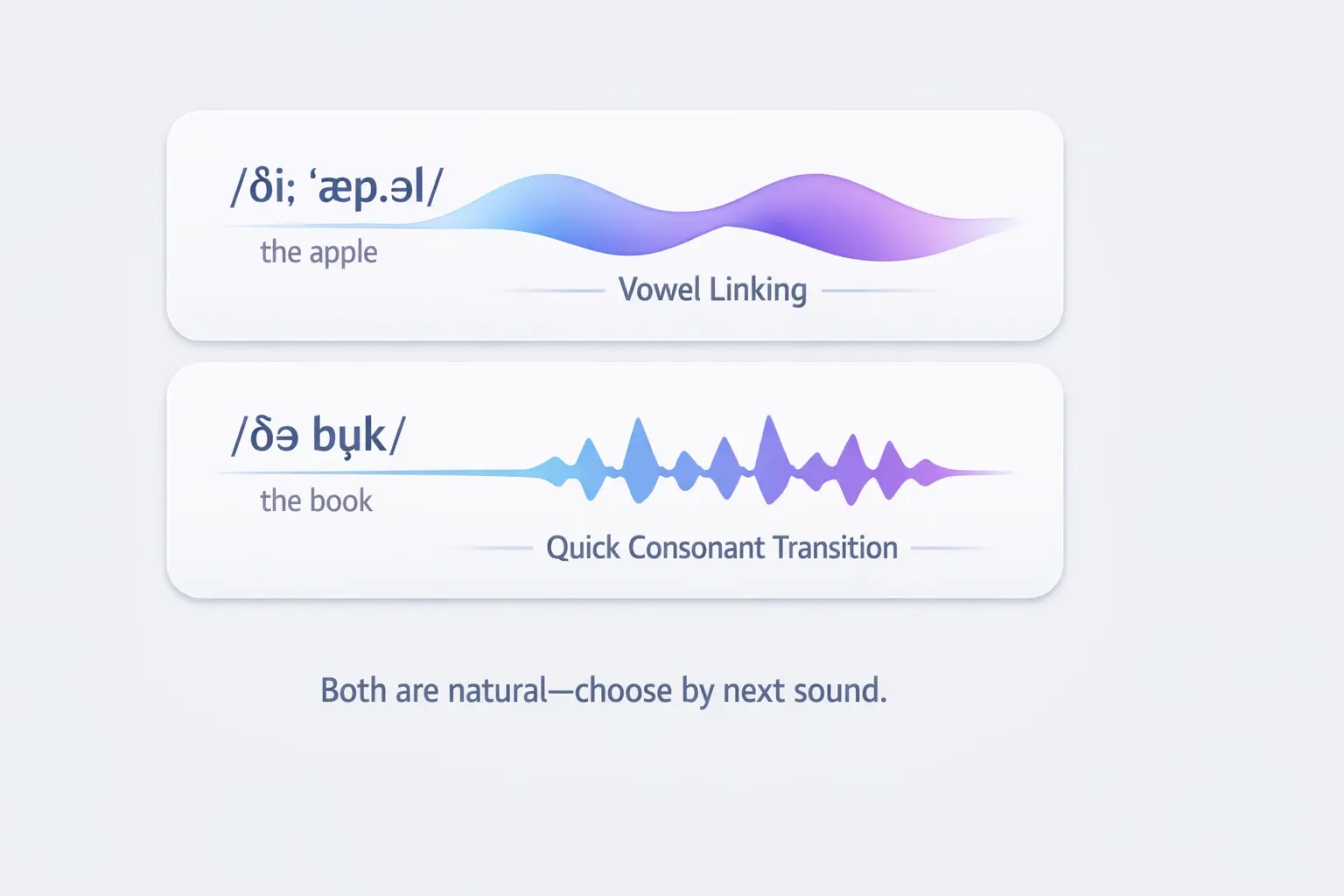
The word "the" is like a hinge between words. A hinge moves differently depending on what is attached next. Before consonant sounds, /ðə/ keeps movement compact. Before vowel sounds, /ðiː/ creates a smoother glide and prevents awkward collision.
This is not about sounding fancy. It is about reducing friction in speech. Fluent pronunciation often means making transitions easier for both speaker and listener.
High-Value Example Sets (By Situation)
Daily Life
- the bus, the train, the station, the ticket
- the apple, the orange, the egg, the idea
- the hour, the umbrella, the event, the answer
Workplace English
- the meeting, the report, the project, the budget
- the update, the email, the issue, the outcome
- the analyst, the engineer, the intern, the office
Academic or Exam Context
- the lecture, the chapter, the diagram, the question
- the answer, the example, the argument, the evidence
- the IELTS test, the examiner, the interview, the evaluation
Sound-First Exceptions Learners Often Miss
The sound-first rule solves most confusion. These examples are especially useful:
- the hour (/ðiː/) because "hour" starts with vowel sound /aʊ/.
- the honest answer (/ðiː/) because "honest" starts with vowel sound /ɒ/.
- the university (/ðə/) because "university" starts with /juː/.
- the European market (/ðə/) because "European" starts with /j/ sound.
- the one thing (/ðə/) because "one" starts with /w/ sound.
If uncertain, check pronunciation audio and IPA in QuickPronounce. This keeps your rule-based guess aligned with real usage.
When Speakers Use /ðiː/ for Emphasis
Native speakers also use /ðiː/ for emphasis, even before consonant sounds, when they mean something unique or specific:
- "He is thee person for this job." (strong emphasis)
- "That was thee moment everything changed."
Think of this as spotlight pronunciation. It is less about strict environment and more about meaning intensity.
Rhythm Comparison: /ðə/ vs /ðiː/ in Natural Speech
Practice Ladder: From Rule to Natural Habit
- Round 1 - Isolated phrases: say 20 short phrases (10 with /ðə/, 10 with /ðiː/).
- Round 2 - Sentence reading: read 10 mixed sentences at slow pace.
- Round 3 - Contrast drill: alternate pairs: "the book / the apple," "the car / the engine."
- Round 4 - Monologue transfer: describe your day for 45 seconds and track every "the."
- Round 5 - Feedback loop: listen and mark any mismatches.
This ladder works because it starts controlled and ends spontaneous. Real speech improvement needs both.
Common Errors and Quick Fixes
Error 1: Using only /ðə/ everywhere. Fix: train vowel-initial phrase sets for 5 minutes daily.
Error 2: Looking at letters, not sounds. Fix: check first sound in IPA, not first letter in spelling.
Error 3: Overthinking in live speech. Fix: automate with contrast drills until response is fast.
Error 4: Ignoring sentence rhythm. Fix: connect this rule with connected speech practice.
Error 5: No recording. Fix: record 60 seconds and audit every "the."
Practice What You've Learned
Quick practice
Train your ear with the Minimal Pairs quiz
Choosing /ðə/ or /ðiː/ comes down to hearing the sound that follows. The Minimal Pairs quiz drills that same listen-and-choose skill on the vowel and consonant contrasts learners mix up most.
Take the Minimal Pairs quiz →Frequently Asked Questions
Is it "thuh" or "thee"?
Both are correct. Use /ðə/ ("thuh") before a consonant sound and /ðiː/ ("thee") before a vowel sound. It follows the sound that comes next, not the spelling.
How do you pronounce "the" before a vowel?
Use /ðiː/ ("thee"): the apple, the hour, the end. This includes words that start with a consonant letter but a vowel sound, like "hour."
Why do speakers sometimes say "thee" before a consonant?
For emphasis. Saying "He is thee person for this job" marks the noun as unique or important. It's a deliberate choice, not the default.
Does it matter if I get "the" wrong sometimes?
One slip isn't a problem. But because "the" is so common, a repeated mismatch makes speech sound less smooth, so it's worth training until the choice is automatic.
Is "thee" more formal than "thuh"?
No. Neither version is more formal. The choice depends on the following sound and, occasionally, on emphasis.
Final Takeaway: Tiny Rule, Big Clarity Gain
"The" may be a short word, but mastering /ðə/ and /ðiː/ gives your speech smoother rhythm and cleaner transitions. In fluent speech, small function words carry big rhythm value. That is why this topic is worth focused practice.
Keep it simple: follow the sound-first rule, train with contrast phrases, and validate with recording. Over a few weeks, this choice becomes automatic. When it does, your English sounds more natural without extra effort.
Start Practicing
Use QuickPronounce to check IPA, compare accents, and improve clarity.
Open QuickPronounce