
How to Pronounce Silent Letters in English Correctly
On this page
- What Are Silent Letters in English?
- Why Does English Have Silent Letters?
- 8 Silent Letter Rules Every English Speaker Must Know
- Top 3 Most Mispronounced Words with Silent Letters
- How to Master Silent Letters with QuickPronounce
- 5 Daily Practice Tips to Master Silent Letters
- Practice What You've Learned
- Frequently Asked Questions
- Final Thoughts: Confidence Through Clarity
What Are Silent Letters in English?
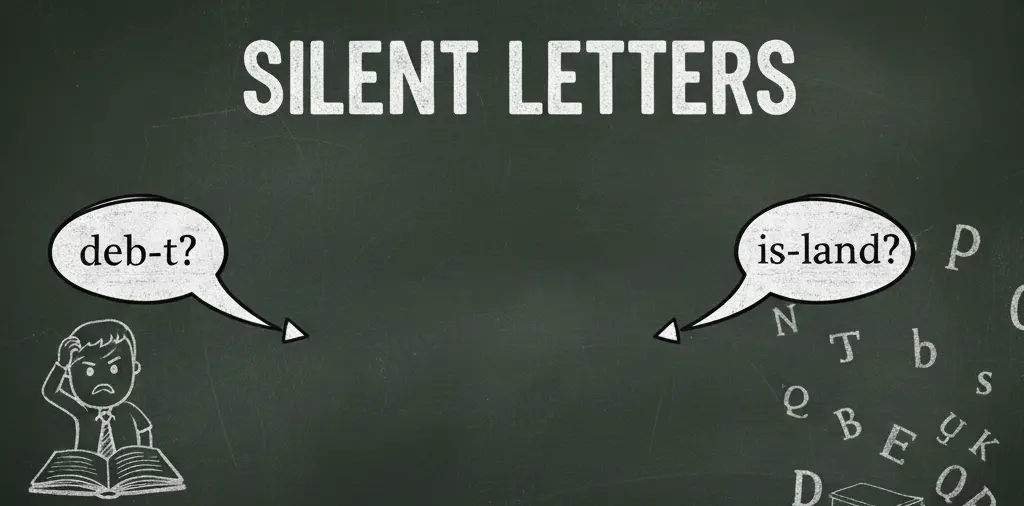
Are you pronouncing 'deb-t' with a hard 'b' sound? Walking on an 'is-land' with an 's'? If you've ever struggled with words where a letter is written but not spoken, you've encountered one of English's most frustrating quirks: silent letters.
Silent letters are letters that appear in the spelling of a word but produce no sound when spoken. They're invisible to the ear but visible to the eye, creating a disconnect between written and spoken English that trips up both learners and native speakers.
- Over 60% of English words contain at least one silent letter
- The most common silent letters are: E, B, K, L, P, G, H, T, W
- Silent letters are remnants of Old English and borrowed languages
- Learning IPA (International Phonetic Alphabet) is the key to mastering them
This comprehensive guide will explain why these silent letters exist, teach you the 8 most important pronunciation rules, and show you how to use QuickPronounce's IPA-based pronunciation checker to never mispronounce a word again.
Why Does English Have Silent Letters?
The existence of silent letters isn't a random quirk - it's a fascinating story rooted in the historical evolution of the English language. Understanding the "why" helps you remember the "how."
1. Etymology: Borrowing from Other Languages
English is a linguistic melting pot. Many silent letters are remnants of words borrowed from Latin, Greek, French, and other languages. When English adopted these words, it often kept the original spelling even after pronunciation changed.
- 'Psychology' (silent P): From Greek psyche (ψυχή)
- 'Debt' (silent B): From Latin debitum
- 'Receipt' (silent P): From Latin receptum
- 'Island' (silent S): Actually an Old English word igland, but the 's' was added later to make it look more like Latin insula
2. The Great Vowel Shift (1400-1700)
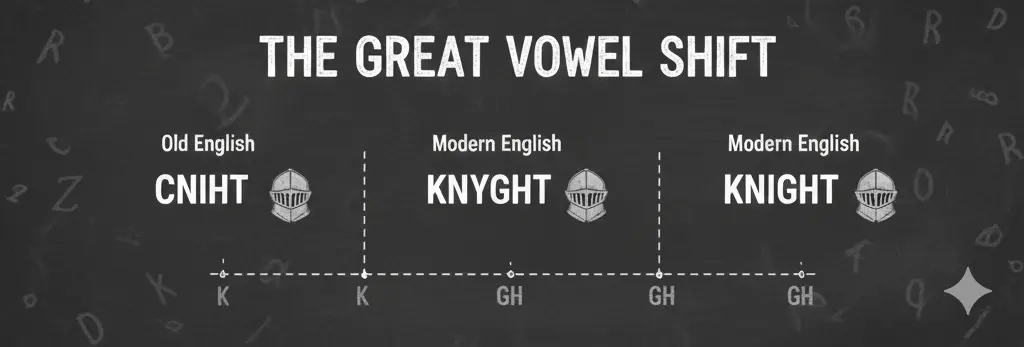
Between the 15th and 18th centuries, English pronunciation underwent massive changes called the Great Vowel Shift. Vowel sounds changed dramatically, but spelling largely stayed the same. This left behind many consonants that were once pronounced but are now silent.
- 'Knight': In Old English (cniht), both the 'k' and 'gh' were pronounced
- 'Knife': Originally pronounced with a hard 'k' sound
- 'Gnome': The 'g' was once pronounced in Greek
English spelling is a historical record of where words came from. The IPA (International Phonetic Alphabet) is the current sound record of how they're pronounced today. This is why relying on IPA transcription is the only foolproof way to know correct pronunciation.
8 Silent Letter Rules Every English Speaker Must Know
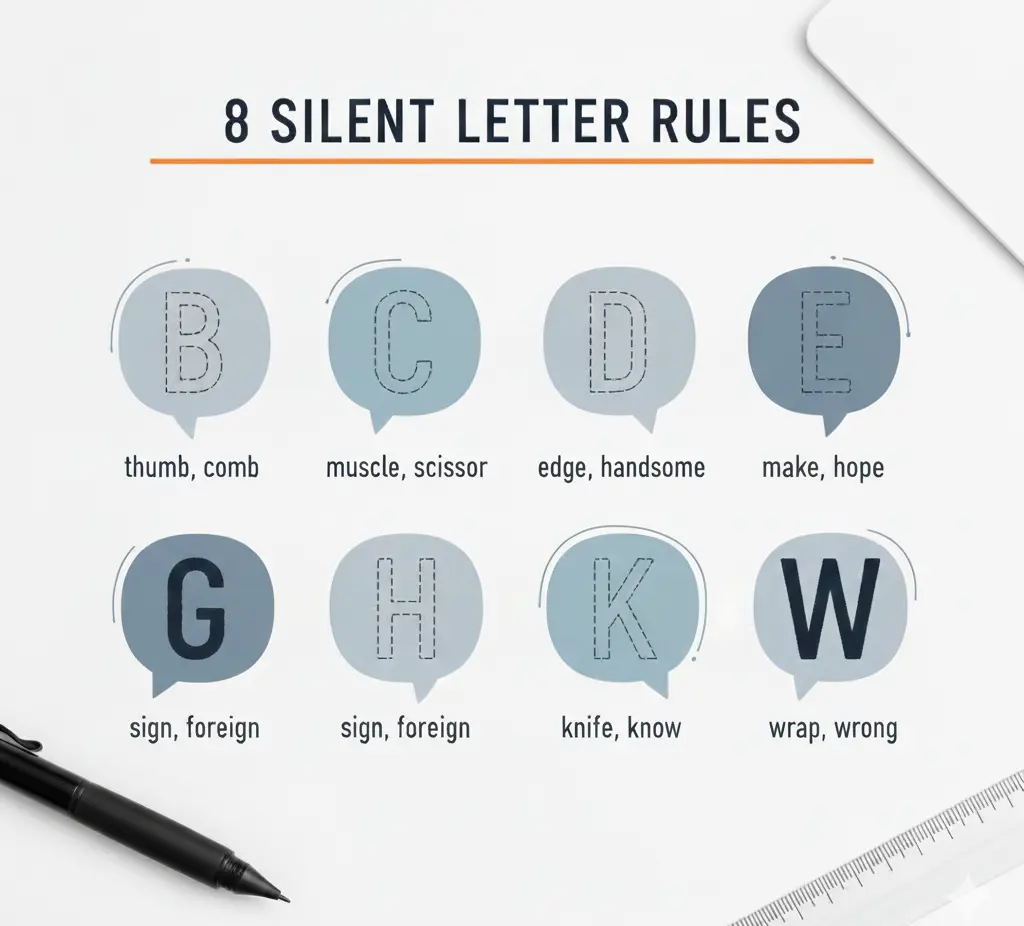
While English pronunciation can seem chaotic, there are predictable patterns for silent letters. Master these 8 rules, and you'll be able to pronounce thousands of words correctly.
Silent B
The 'B' is usually silent after 'M' at the end of a word, or before 'T'.
- Debt/dɛt/
- Doubt/daʊt/
- Thumb/θʌm/
- Climb/klaɪm/
- Lamb/læm/
- Comb/koʊm/
Silent K
The 'K' is always silent before 'N' at the beginning of a word.
- Know/noʊ/
- Knife/naɪf/
- Knee/niː/
- Knowledge/ˈnɒlɪdʒ/
- Knight/naɪt/
- Knock/nɒk/
Silent L
The 'L' is often silent after the vowels 'A', 'O', and 'U'.
- Calm/kɑːm/
- Talk/tɔːk/
- Should/ʃʊd/
- Salmon/ˈsæmən/
- Walk/wɔːk/
- Would/wʊd/
Silent P
The 'P' is usually silent at the beginning of words before 'S', 'T', or 'N'.
- Psychology/saɪˈkɒlədʒi/
- Pneumonia/njuːˈmoʊniə/
- Receipt/rɪˈsiːt/
- Pseudonym/ˈsuːdənɪm/
Silent G
The 'G' is silent before 'N' at the beginning or end of words.
- Gnome/noʊm/
- Sign/saɪn/
- Foreign/ˈfɒrɪn/
- Design/dɪˈzaɪn/
Silent H
The 'H' is silent in some words, especially after 'W' or at the beginning.
- Hour/aʊər/
- Honest/ˈɒnɪst/
- Heir/ɛər/
- Vehicle/ˈviːəkəl/
Silent T
The 'T' is silent in many common words, especially in the middle of a word.
- Listen/ˈlɪsən/
- Castle/ˈkɑːsəl/
- Whistle/ˈwɪsəl/
- Christmas/ˈkrɪsməs/
- Fasten/ˈfæsən/
Silent W
The 'W' is silent at the beginning of a word before 'R'.
- Write/raɪt/
- Wrong/rɒŋ/
- Answer/ˈɑːnsər/
- Sword/sɔːrd/
- Wreck/rɛk/
When you encounter unfamiliar words with these letter combinations, always suspect a silent letter:
- KN- at the start (knife, know)
- -MB at the end (climb, thumb)
- PS- at the start (psychology, psalm)
- GN- at the start or -GN at the end (gnome, sign)
- WR- at the start (write, wrong)
Top 3 Most Mispronounced Words with Silent Letters
Even native English speakers struggle with these tricky words. Here are the most common pronunciation mistakes and how to avoid them:
February
Tip: The first 'r' is often dropped in casual speech
Wednesday
Tip: The 'd' after 'n' is silent
Colonel
Tip: Pronounced like 'kernel' - silent 'l' and 'o'
How to Master Silent Letters with QuickPronounce
The best way to defeat silent letters is to stop trusting the spelling and start trusting the sound. Here's your 4-step system to master any word with silent letters:
- Identify suspicious patterns. When you see letter combinations like 'KN', 'MB', 'PS', 'GN', or 'WR', immediately suspect a silent letter. Words borrowed from Greek (psychology, pneumonia) and French (debris, ballet) are also prime suspects.
- Check the IPA transcription. Enter the word into QuickPronounce. Look at the IPA transcription carefully. If the sound you expect is missing, you've found your silent letter! For example, receipt shows /rɪˈsiːt/ with no /p/ sound anywhere.
- Listen to multiple accents. Use QuickPronounce's audio feature to hear the correct pronunciation in American, British, Australian, and other accents. Silent letters remain silent across all English dialects, which makes this rule very reliable.
- Practice with context sentences. Don't just repeat the word in isolation. Use it in full sentences: "I doubt I will climb that mountain." This trains your mouth muscles and makes the correct pronunciation automatic in natural speech.
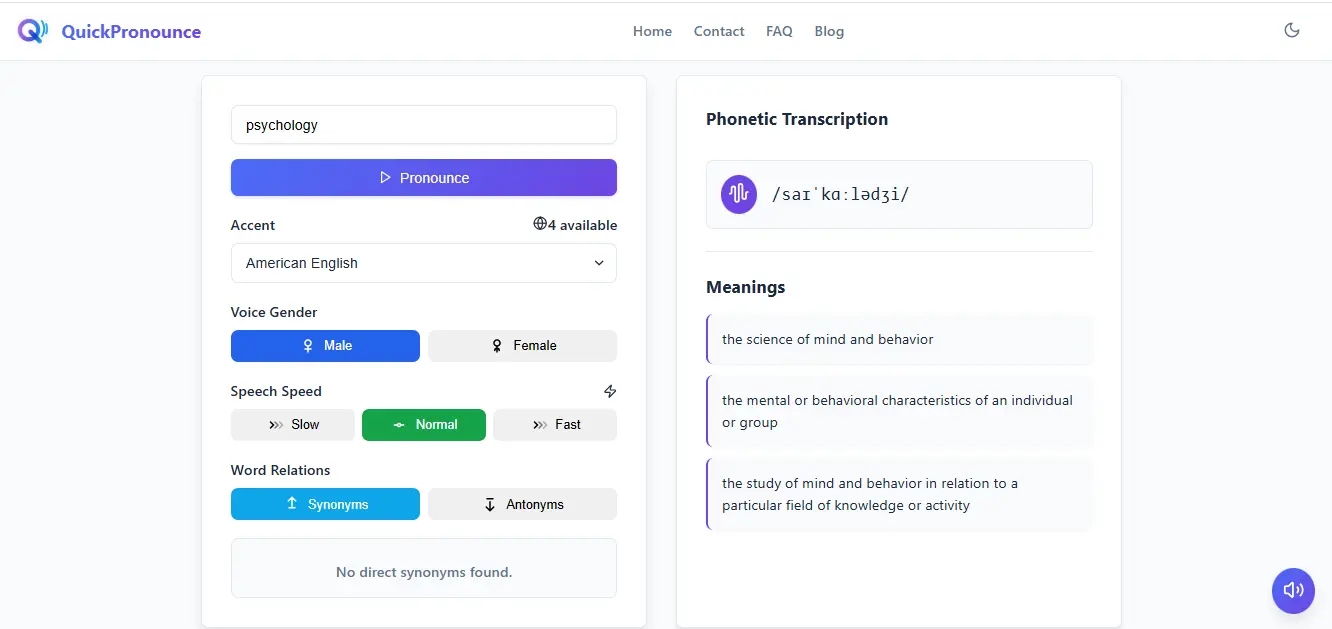
If you're building a spelling or pronunciation tool, the QuickPronounce phonetic API returns the IPA transcription for US and UK on every word, so you can detect a missing sound (the silent letter) programmatically instead of by eye. Free while in public testing, one API key by email.
5 Daily Practice Tips to Master Silent Letters
📚 Create a Silent Letter Journal
🎯 Practice Minimal Pairs
🔊 Record Yourself
👥 Find a Practice Partner
📖 Read Aloud Daily
Practice What You've Learned
Quick practice
Test yourself with a silent letters quiz
You've learned the 8 rules and the suspicious letter patterns. Now put them to work: listen to real words and pick out the letter that's written but never spoken.
Take the Silent Letters quiz →Frequently Asked Questions
What are silent letters in English?
Silent letters are letters that are written but not pronounced, like the 'k' in 'knife', the 'b' in 'debt', or the 'l' in 'salmon'. Most exist because English kept the old spelling after the pronunciation changed, or borrowed a word and its spelling from another language.
How do I know which letter is silent in a word?
Check the IPA transcription. If a letter in the spelling has no matching sound in the IPA, it's silent. Common patterns include silent 'k' before 'n', silent 'b' after 'm', and silent 'w' before 'r'.
What are the most common silent letters?
Silent B, K, L, P, G, H, T, and W cover most cases. Words like 'comb', 'know', 'half', 'psychology', 'sign', 'hour', 'listen', and 'wrist' each drop one of them.
Why does English have so many silent letters?
Spelling was fixed by early printing while speech kept changing, so pronunciations simplified but the letters stayed. Loanwords from French, Greek, and Latin brought their own silent-letter patterns too.
Do silent letters ever get pronounced?
Sometimes, depending on the word or the speaker. The 't' in 'often' is silent for many speakers but pronounced by others, and related words can differ, like the silent 'n' in 'autumn' next to a pronounced 'n' in 'autumnal'.
Final Thoughts: Confidence Through Clarity
Silent letters are a unique challenge in English pronunciation, but they're not insurmountable. By understanding the historical reasons behind them, learning the 8 core pronunciation rules, and consistently using the International Phonetic Alphabet (IPA) as your guide, you can confidently navigate even the trickiest words in the English language.
Remember: English spelling tells you where a word came from; IPA tells you how it sounds today. Whenever you're in doubt, trust the IPA transcription, not the spelling.
Your Next Steps
- Bookmark this guide for future reference
- Try QuickPronounce on 5 words you've been unsure about
- Practice one silent letter rule per day this week
- Share this guide with anyone learning English
Stay tuned for our next guide, where we'll dive deep into Word Stress Patterns - the key to sounding natural and fluent in English conversation! In the meantime, see the Word Stress Rules Guide.
Get pronunciation as you read: the QuickPronounce extension works on any page, not just this one.
Add to ChromeReady to Stop Guessing?
Use QuickPronounce's free pronunciation checker to instantly verify any word with IPA and audio in multiple accents.
Check Your Pronunciation Now